eQMS for Clinical Trials: What a Quality System Must Deliver in a GCP Environment and How Biotechs Should Choose One

Last updated: October 2026
Short answer: An eQMS for clinical trials has to run the processes a sponsor uses to manage and evidence trial quality. These are controlled SOPs and documents, deviations with root cause analysis and CAPA, change control, training records, qualification of suppliers and CROs, and audits. Since 23 July 2025, ICH E6(R3) has required a risk-based quality management system in the EU (section 3.10). The system itself must be validated under section 4.3, with a reliable audit trail and user management. When choosing one, check four things: the vendor’s validation package, an audit trail that is readable and exportable, a least-privilege role model and the link to the eTMF. Then cover hosting and the contract (data location, audit rights, access if the vendor fails) in line with Annex 1 of the EMA guideline on computerised systems.
This page covers the system and its processes: what the eQMS must do during the trial and how to choose it. For how sponsors evidence inspection readiness and oversight, see our guide to ICH E6(R3) inspection readiness for sponsors.
1. What an eQMS must actually do in a clinical trial
ICH E6(R3) does not mandate an eQMS. It does require the sponsor to “implement an appropriate system to manage quality throughout all stages of the trial process” (3.10), and to set up QA and QC processes with documented procedures (3.11). For a Phase I/II biotech, that means six core functions:
- Document control: SOPs, plans and templates with versioning, review, approval and signature. Appendix C.2.1 expects records to be identifiable and version-controlled, naming authors, reviewers and approvers with date and signature. Non-trial-specific records such as SOPs and validation records may be held outside trial-specific repositories (C.2.12), which is exactly where the eQMS and the eTMF meet. Requirements for pure document management are covered in eDMS requirements for biotechs and CROs.
- Deviations and CAPA: where noncompliance could significantly affect participants’ rights, safety or the reliability of results, the sponsor should carry out root cause analysis, implement CAPA and confirm it works (3.12.2). QA should use risk-based strategies to find the causes of serious noncompliance so that corrective and preventive action can follow (3.11.1).
- Change control: changes to systems are validated on a risk basis and follow change control procedures (4.3.4(c)). The EMA expects a formal change control process with risk assessment and version control (EMA/INS/GCP/112288/2023, Annex 2, A2.10).
- Training: the sponsor must use qualified people (3.4). Anyone using computerised systems must be trained in them (4.3.2), and training must be documented and available for inspection (EMA guideline, 5.3).
- Supplier and CRO qualification: the sponsor assesses whether service providers are suitable and selects them (3.6.7). It needs access to their SOPs and performance metrics (3.6.8) and oversees transferred activities, including any subcontracting (3.6.9).
- Audits: audits are independent of monitoring, proportionate to risk and follow documented procedures setting out what is audited, how, how often and how it is reported (3.11.2, 3.11.2.2).
An eQMS does not replace these obligations. It makes them provable: every deviation is linked to its SOP, training and CAPA, and every approval carries an attributable audit trail entry.
2. The rules behind it (with exact references)
ICH E6(R3): what 3.10, 3.16 and section 4 actually say
ICH adopted the final E6(R3), comprising the Principles and Annex 1, on 6 January 2025. It has applied in the EU since 23 July 2025 (EMA/CHMP/ICH/135/1995, Step 5). The FDA issued it as final, non-binding guidance on 8 September 2025, and the Federal Register notice followed on 9 September 2025 (90 FR 43460, docket FDA-2023-D-1955). According to the ICH Efficacy Guidelines page, “Annex 2 was subsequently adopted on 3 June 2026”; ECA Academy reports CHMP adoption on 25 June 2026; and the EU’s ACT EU GCP modernisation page states that “Annex 2 comes into effect on 15 January 2027”. Annex 2, on decentralised and pragmatic trials, matters less for core eQMS requirements.
Correcting the section mapping: the sections named in the brief are right in substance but do not cover every eQMS function.
- 3.10 Quality Management: a system to manage quality across all trial stages, quality by design and critical-to-quality factors. Section 3.10.1 then sets out risk management: identification, evaluation, control, communication, review and reporting. Risks must explicitly be considered “across the processes and systems, including computerised systems” (3.10.1.1).
- 3.16 Data and Records: data handling (3.16.1), record keeping and retention (3.16.3) and record access (3.16.4). For system selection, 3.16.1(x) is central. The sponsor keeps a record of important computerised systems and their validation status (i), ensures validation, audit trails, user management, backup, disaster recovery and IT security are in place (ii), and keeps a record of authorised users with their roles and permissions (iii).
- 4 Data Governance – Investigator and Sponsor: 4.2 covers the data life cycle, including audit trails (4.2.2) and transfer and migration (4.2.5). 4.3 covers computerised systems: procedures, training, security, validation (4.3.4), system failure and user management (4.3.8).
- Also needed: CAPA, audits and service providers additionally require 3.6 (agreements and service providers), 3.9 (sponsor oversight), 3.11 (QA, QC and audit) and 3.12 (noncompliance, with root cause analysis and CAPA).
EU Regulation 536/2014 (Clinical Trials Regulation)
- Art. 47: sponsor and investigator ensure the trial follows the protocol and GCP.
- Art. 52: the sponsor reports serious breaches through the EU portal “without undue delay but not later than seven days” after becoming aware of them. In the eQMS, deviation management therefore needs a “potential serious breach” escalation with deadline tracking.
- Arts. 57–58: sponsor and investigator keep a trial master file and archive its content for at least 25 years after the trial ends. Archiving must keep the content complete, legible and available to authorities, and any changes must be traceable.
- Art. 71: the sponsor may delegate tasks by written contract but remains responsible.
21 CFR Part 11 (trials under a US IND)
- 11.10: controls for closed systems. These include validation (a), limited access (d), “secure, computer-generated, time-stamped audit trails” (e), authority checks (g), training (i) and control of system documentation (k).
- 11.50: the signature manifestation shows the name, date and time, and the meaning of the signature.
- 11.70: the signature is permanently linked to its record.
- 11.100: each signature is unique to one person and never reused or reassigned.
For detail, see our 21 CFR Part 11 electronic signatures guide.
EU GMP Annex 11
Annex 11 (EudraLex Vol. 4) is a GMP guideline, and the 2011 text remains in force. The European Commission and PIC/S published a full draft revision for consultation on 7 July 2025 (closing 7 October 2025), together with a revised Chapter 4 and a new Annex 22 on AI. In GCP inspections Annex 11 serves only as a reference. The governing document for clinical trials is the EMA guideline on computerised systems.
EMA Guideline on computerised systems and electronic data in clinical trials
Guideline EMA/INS/GCP/112288/2023 was adopted by the GCP IWG on 7 March 2023, published on 9 March 2023 and has applied since September 2023. Its scope explicitly names eTMFs and document management systems. These sections matter for eQMS selection:
- 4.10 and Annex 2 (validation): under A2.1 you may rely on the vendor’s validation documentation once you have assessed it, for example through an audit, but responsibility stays with the sponsor. Annex 2 also covers periodic review (A2.9) and change control (A2.10).
- 6.2 (audit trail): ordinary users must not be able to switch it off; it must be human-readable and fully exportable, and it records what, who, when and why.
- 5.4 and Annex 3 (user management): segregation of duties (A3.3), least privilege (A3.4) and no shared accounts (A3.5).
- 6.7 (cloud): the cloud provider must be qualified, data jurisdiction must be settled in the contract, and your own validation needs a test environment identical to production.
- Annex 1 (agreements): a vendor that will not support pre-qualification audits or inspections should not be used. The data storage location must be described, and access must be secured if the vendor becomes insolvent or you switch vendor.
- 6.10 (migration): validating a data migration deserves “no less focus” than validating the system itself.
3. Sponsor biotech or CRO: how the eQMS differs
- Sponsor biotech: the sponsor keeps overall responsibility, including for transferred activities (ICH E6(R3), Principle 10.1 and 3.6.6). Its eQMS must therefore centre on oversight: qualifying and auditing the CRO and vendors, a register of transferred tasks, an escalation route for serious breaches under Art. 52, and access to the TMF sections the CRO holds.
- CRO: every service provider should “implement appropriate quality management” and report relevant incidents to the sponsor (3.6.6). Existing QM processes are acceptable if they are fit for purpose for the trial (3.6.10). At system level the difference shows mainly in client segregation: permissions per sponsor and project, sponsor access to the eTMF, and readiness for client audits. The EMA guideline applies explicitly to service providers too.
For the CRO perspective in depth, see eQMS for CROs: GCP requirements.
4. Selection criteria and what sits behind them
The table below maps each requirement to its regulatory reference and the specific question to ask during selection.
| eQMS requirement | Regulatory reference | What to check during selection |
|---|---|---|
| Validated system | ICH E6(R3) 4.3.4; 21 CFR 11.10(a); EMA guideline 4.10, Annex 2 | Does the vendor supply IQ/OQ documentation and PQ/UAT templates? Can you audit the vendor? How are releases announced and validated? |
| Audit trail | ICH E6(R3) 4.2.2; 21 CFR 11.10(e); EMA guideline 6.2 | Can users not switch it off? Is it human-readable and fully exportable, with old and new value, user, role, timestamp and reason? |
| Roles and permissions | ICH E6(R3) 3.16.1(x)(iii), 4.3.8; EMA guideline Annex 3 | Is there least privilege, segregation of duties, individual accounts, a history of permission changes and periodic user reviews? |
| Electronic signature | 21 CFR 11.50, 11.70, 11.100; EMA guideline 4.8 | Does the signature show name, time and meaning? Is it permanently linked to the record, with re-authentication at signing? |
| Deviations and CAPA | ICH E6(R3) 3.11.1, 3.12.2; EU CTR Art. 52 | Can root cause analysis be documented? Is there an effectiveness check, a serious breach escalation with the seven-day deadline, and a link to SOP and training? |
| Change control | ICH E6(R3) 4.3.4(c); EMA guideline A2.10 | Are there change requests with risk assessment, impact analysis on the validated state, and versioning? |
| Training | ICH E6(R3) 3.4, 4.3.2; EMA guideline 5.3 | Is SOP training assigned automatically when a new version is released, and can records be exported at any time? |
| Supplier and CRO qualification | ICH E6(R3) 3.6.7–3.6.9; EMA guideline Annex 1 | Is there an approved supplier list, audit planning, a link from findings to CAPA, and requalification dates? |
| eTMF integration | EU CTR Arts. 57–58; ICH E6(R3) Appendix C.2.4 | Is the eTMF structured on the TMF Reference Model? Are approved versions linked without duplicate filing? Can the TMF be archived for 25 years? |
| Hosting and contracts | EMA guideline 4.9, 6.7, Annex 1; GDPR Arts. 45–49 | Where are data and backups held? Who are the subprocessors? What happens on insolvency or exit? Is there a data processing agreement (DPA)? |
Three points deserve particular attention:
- Validation package: “pre-validated” means the vendor carries out IQ and OQ for its software. Assessing intended use and running the PQ in your own processes remain your job (EMA guideline A2.1). The ISPE’s GAMP 5 Second Edition (July 2022) sets out the risk-based approach. The FDA’s final “Computer Software Assurance” guidance of 24 September 2025 is formally aimed at medical device manufacturers but follows the same logic.
- eTMF integration: keeping the eQMS and eTMF separate creates duplicate records in diverging versions. A proper integration references approved SOP and plan versions directly in the eTMF. For market overviews, see the eTMF software comparison 2026 and the eQMS software comparison 2026.
- Pricing for small teams: look for per-user licences without high minimums, validation documentation included in the price, monthly cancellation, and the cost of exporting your data on exit. For a 15-person biotech, validation and implementation often cost more than the licence.
5. Typical inspection findings on quality systems
EMA, Annual Report of the GCP Inspectors Working Group 2023 (EMA/INS/GCP/164938/2024, dated 8 November 2024): 67 CHMP-requested inspections produced 720 findings, of which 36 were critical, 336 major and 348 minor. The “Computer System” category accounted for 46 findings (5 critical, 22 major). Sponsors were responsible for 23 of the 36 critical findings (63.9%). Examples from the report:
- “Lack of SOPs for the development of essential trial documents”
- “Deficient process to select, review, and approve SOPs for critical trial related processes”
- “No audits conducted of partners/vendors engaged in activities on behalf of the sponsor”
- “Lack of /unclear documentation of duties/tasks delegated to service providers by the sponsor”
- “Lack of inspection readiness: limitations in eTMF access”
MHRA, GCP Inspections Metrics Report 2019–2020 (report dated 29 March 2023, re-issued 11 April 2023): the MHRA carried out 36 GCP inspections, covering 7 commercial sponsors, 5 CROs, 4 non-commercial organisations, 4 Phase 1 units and 12 investigator sites; 4 of the 7 commercial sponsors (57.1%) received at least one critical finding. All four critical findings at commercial sponsors concerned pharmacovigilance, and all four traced back to earlier inspections: finding 1 cites “a failure to implement Corrective and Preventative Actions (CAPA) for previous major inspection findings”, finding 2 CAPA from two previous inspections that “continued to be ineffective”, finding 3 a previous CAPA that was “not robust”, and finding 4 noncompliance that “had not been rectified”. Of the 5 CROs inspected, one received all four critical findings (Data Integrity Control Processes, IMP Management, Data Integrity, Protocol Compliance); under the first, the MHRA found that “The audit trail provided from the eCRF system was not in a suitable format to aid review” and that “The IRT audit trail … could not be provided … as it had been decommissioned by the vendor.” At a joint university/trust non-commercial sponsor, the MHRA found that “The UK sponsor file only contained documentation relating to the regulatory approval of each site and contractual arrangements”, because the records were held by a non-EU co-sponsor. The MHRA has not published a newer GCP metrics report on gov.uk (collection page last updated 28 March 2023).
FDA, Warning Letter to Applied Therapeutics, Inc. (24-HFD-45-11-01, dated 27 November 2024, posted 3 December 2024): the letter cites 21 CFR 312.58. A third-party vendor contracted by the sponsor deleted eCOA data for primary and secondary endpoints on 27 March 2024, including the audit trails, for all 47 subjects. The FDA judged the CAPA response inadequate because it “did not include sufficient details about your corrective action plan”.
FDA, Warning Letter to Amy Lightner, MD (sponsor-investigator, 25 March 2025): the letter cites 21 CFR 312.50 (ensuring proper monitoring) and 312.57(c) (record retention).
The same patterns recur: missing or inadequate SOPs, CAPA that does not work, no audits of service providers, audit trails that cannot be reviewed or are lost at the vendor, and restricted eTMF access. Each one traces back to a selection criterion in the table above.
Docuply in context
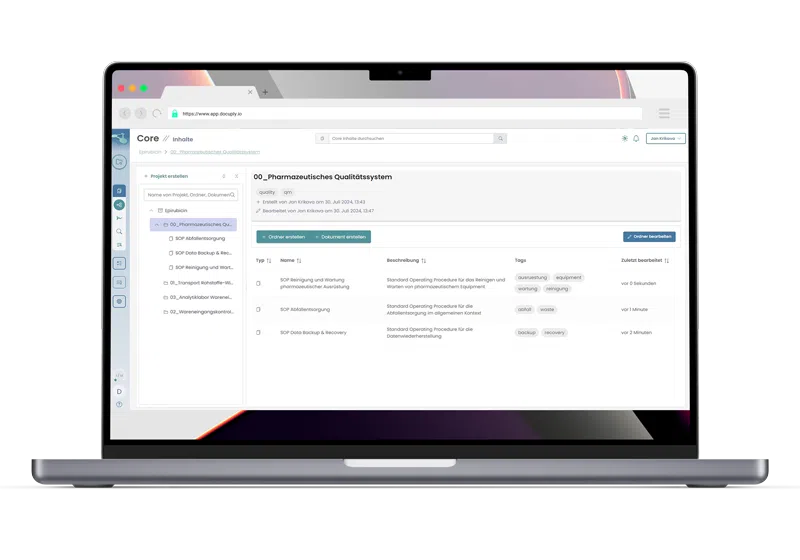
Docuply is an eQMS with a fully integrated eTMF for clinical biotechs in Phase I and II and their CROs. The vendor is based in Mannheim and hosts in the EU cloud. According to docuply.io, it offers:
- the modules Document Management, Training Hub, Quality Events (deviations and CAPA, with AI suggestions for root causes and actions), Supplier Management, Trial Master File and GxP Archive
- an eTMF structured on the CDISC TMF Reference Model
- signatures compliant with 21 CFR Part 11 and Annex 11
- a pre-validated system with IQ/OQ documentation
- ISO 27001 certification
- granular permissions per project and sponsor
The licence costs €99 per user per month for up to 50 users. It includes IQ/OQ, initial vendor qualification and initial staff training, and can be cancelled monthly. A free eDMS tier is available for up to 8 users. As with any vendor, the PQ in your own processes remains the customer’s responsibility.
Decision guide by segment
- First Phase I trial (10–30 staff): before first patient in, put a lean SOP set, a training matrix, deviations and CAPA, and supplier qualification into one validated system. What matters is a pre-validated package with IQ/OQ, low validation effort for the PQ, and an eTMF link from day one. Switching systems mid-trial costs more than choosing well now.
- Trial with CRO involvement: here the oversight functions matter most. They include CRO audit and qualification, a register of transferred tasks (ICH E6(R3) 3.6.4), a link from CRO findings to your CAPA process, serious breach escalation within seven days, and contractually secured access to the CRO’s TMF sections. Check that external users can be invited with restricted roles. For inspection preparation, see the TMF inspection readiness guide 2026.
- Moving from SharePoint or paper: SharePoint is not a validated GxP system until validation, audit trail and user management have been demonstrated. Treat the migration as a validated process: risk analysis, a dry run with mock data, verification of key data and preservation of metadata (EMA guideline 6.10; ICH E6(R3) 4.2.5). Migrate current SOP versions with their approval history and archive legacy material read-only.
- Small founder-led CRO: prioritise segregation by sponsor, sponsor access to the eTMF, client audits and a pricing model that scales with the number of projects. More in eQMS for CROs.
FAQ
Does ICH E6(R3) require an electronic QMS?
No. ICH E6(R3) is media-neutral and requires an appropriate system to manage quality (3.10). If that system is electronic, the computerised system requirements in 3.16.1(x) and section 4 apply.
Is the vendor’s validation documentation enough?
Only in part. Under the EMA guideline (A2.1) you may rely on it once you have assessed it, for example by audit, and only if it covers your own intended use. Responsibility for the validated state stays with the sponsor.
Does EU GMP Annex 11 apply to clinical trials?
Annex 11 is a GMP guideline. For computerised systems in clinical trials, EMA/INS/GCP/112288/2023 is the governing guidance. Annex 11 serves as a supplementary reference, and its revision has been in draft since July 2025.
Do we need 21 CFR Part 11 if we only run trials in the EU?
Legally, no. If you may submit data in the US later, Part 11-capable signatures and audit trails from the outset will save rework.
How long must eQMS records be kept?
TMF content must be archived for at least 25 years after the trial ends (EU CTR Art. 58). SOPs and validation records that are essential to the trial count as essential records (ICH E6(R3) C.2.12) and should stay available for as long.
Do the eQMS and eTMF have to come from one vendor?
No. Separate systems need validated interfaces (ICH E6(R3) 4.3.4(e)) and a clear rule on which system holds the master record.
Sources
- ICH, Guideline for Good Clinical Practice E6(R3), final version, 6 January 2025: https://database.ich.org/sites/default/files/ICH_E6(R3)_Step4_FinalGuideline_2025_0106.pdf
- EMA, ICH E6(R3) Step 5, effective 23 July 2025: https://www.ema.europa.eu/en/documents/scientific-guideline/ich-e6-r3-guideline-good-clinical-practice-gcp-step-5_en.pdf
- Federal Register, E6(R3) Good Clinical Practice, 9 September 2025: https://www.federalregister.gov/documents/2025/09/09/2025-17311/e6r3-good-clinical-practice-international-council-for-harmonisation-guidance-for-industry
- Regulation (EU) No 536/2014, EUR-Lex: https://eur-lex.europa.eu/eli/reg/2014/536/oj/eng
- 21 CFR 11.10, eCFR: https://www.ecfr.gov/current/title-21/chapter-I/subchapter-A/part-11/subpart-B/section-11.10
- EMA, Guideline on computerised systems and electronic data in clinical trials, 9 March 2023: https://www.ema.europa.eu/en/documents/regulatory-procedural-guideline/guideline-computerised-systems-and-electronic-data-clinical-trials_en.pdf
- EMA, Notice to sponsors on validation and qualification of computerised systems: https://www.ema.europa.eu/en/documents/regulatory-procedural-guideline/notice-sponsors-validation-qualification-computerised-systems-used-clinical-trials_en.pdf
- European Commission, consultation on Chapter 4, Annex 11 and Annex 22, July 2025: https://health.ec.europa.eu/consultations/stakeholders-consultation-eudralex-volume-4-good-manufacturing-practice-guidelines-chapter-4-annex_en
- EMA, Annual Report of the GCP IWG 2023, 8 November 2024: https://www.ema.europa.eu/system/files/documents/report/annual-report-good-clinical-practice-inspectors-working-group-2023_en.pdf
- MHRA, GCP Inspections Metrics Report 2019–2020, 29 March 2023: https://assets.publishing.service.gov.uk/media/64357bfe89f19f00133cfb40/GCP_inspection_metrics_2019-2020.pdf
- FDA, Warning Letter Applied Therapeutics, Inc., 27 November 2024: https://www.fda.gov/inspections-compliance-enforcement-and-criminal-investigations/warning-letters/applied-therapeutics-inc-696833-12032024
- FDA, Warning Letter Amy Lightner, MD, 25 March 2025: https://www.fda.gov/inspections-compliance-enforcement-and-criminal-investigations/warning-letters/amy-lightner-md-682593-03252025
- Docuply, home page and pricing (accessed October 2026): https://docuply.io/en/ and https://docuply.io/en/pricing/

Author: Jan Krikava – A former life science consultant who founded Docuply on the back of his own consulting experience. 14 years of experience in quality management. Business Informatics B. Sc. LinkedIn: linkedin.com/in/jan-krikava