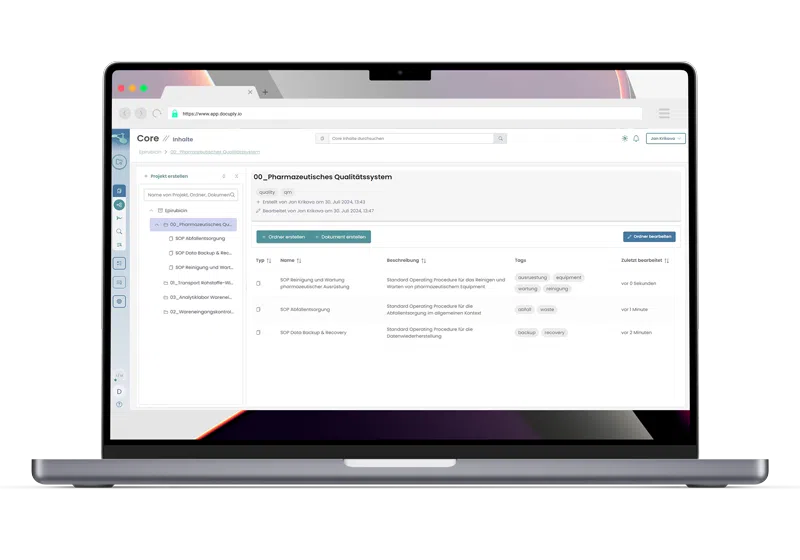
eTMF Software Comparison 2026: The most relevant providers for CROs and biotech companies, from Phase I through to regulatory approval

Last updated: 10 August 2026
Intro
An electronic trial master file (eTMF) is the reconstructible record of what a clinical trial planned, did and documented. For growing sponsors without a dedicated TMF department, the choice of system decides whether an FDA or EMA inspection becomes routine or risk. This comparison is written for clinical operations, quality and regulatory affairs leaders at biotechs from Phase I through approval, and for clinical CROs. Deliberately, this is not a complete market overview but a selection of the eight vendors most relevant to that audience: Docuply, Veeva Vault eTMF, Medidata (Rave eTMF), Viedoc, Flex Databases, Florence eTMF (eBinders), Montrium eTMF Connect and TransPerfect Trial Interactive. All vendor facts were researched via web search in August 2026; uncertain figures are flagged as “per the vendor” or with a date. Docuply, the publisher of this page, is held to the same honest standard as every other vendor, weaknesses included.
Comparison tables (as of August 2026)
Comparison table 1: validation, implementation and operations
| Vendor | Validation effort | Implementation (weeks) | UI/UX | Hosting region / cloud-native |
|---|---|---|---|---|
| Docuply | Low (IQ/OQ included) | approx. 1–3 (start in minutes) | Very simple (deliberately lean) | EU (Germany), cloud-native |
| Veeva Vault eTMF | High | 12–26 (Basics 4–8) | Extensive, complex | US parent, EU data centres available, cloud-native |
| Medidata Rave eTMF | Medium–high | approx. 6–8 | Solid, platform-bound | US (Dassault), cloud-native |
| Viedoc | Low–medium (VIRP included) | approx. 4–6 (30–45 days) | Configurable, modern | EU (Sweden), Azure, cloud-native |
| Flex Databases | Low–medium (validation docs incl.) | approx. 3–6 | Feature-rich | EU available, cloud-native |
| Florence eTMF (eBinders) | Medium | approx. 4–8 (per vendor) | Intuitive, site-oriented | US, cloud-native |
| Montrium eTMF Connect | Low–medium | approx. 4–8 (per vendor) | Simple, without enterprise complexity | EU (Brussels) & Canada (Montreal), Azure, cloud-native |
| TransPerfect Trial Interactive | Medium–high | approx. 8–16 (per vendor) | Feature-rich, enterprise | US/global, cloud-native |
Comparison table 2: price, target audience and CDISC standards
| Vendor | Price transparency | Target organisation size | CDISC TMF Reference Model | CDISC Exchange Mechanism |
|---|---|---|---|---|
| Docuply | High: €99/user/month (~£84) | up to 150 staff biotech and clinical CRO | v3.3.1 fully; TMF Standard Model planned | Yes (supported) |
| Veeva Vault eTMF | no list prices | mid-market to enterprise | DIA TMF RM (version not publicly specified) | Yes (supported) |
| Medidata Rave eTMF | no list prices | mid-market to enterprise (platform users) | DIA TMF RM (version not publicly specified) | no public statement found (as of Aug 2026) |
| Viedoc | no list prices | Phase I–II biotech, CRO | DIA TMF RM (version not publicly specified) | Yes (explicitly documented) |
| Flex Databases | no list prices | CRO, SME to mid-market | TMF RM (version not publicly specified) | Yes (per features page) |
| Florence eTMF (eBinders) | no list prices | sites, sponsors, CRO (site-focused) | DIA TMF RM (version not publicly specified) | no public statement found (as of Aug 2026) |
| Montrium eTMF Connect | no list prices | growing biotech/CRO | TMF RM (version not publicly specified) | vendor leads EMS working group; no explicit product statement found |
| TransPerfect Trial Interactive | no list prices | sponsors/CRO, enterprise | “latest TMF reference model” (version not publicly specified) | involved in EMS development; no explicit product statement found |
Vendor profiles
Docuply
A young German vendor from Mannheim, specialised in biotechs from Phase I through III and beyond, well suited to organisations of up to roughly 150 staff and to clinical CROs. eTMF pricing is integrated into the eQMS licence – one licence for both, €99/user/month (approx. £84), individual quote from 50 users. Strengths: a transparent public list price, EU cloud (ISO 27001, GDPR), IQ/OQ documentation at no surcharge, set-up in minutes, full support for the CDISC TMF Reference Model v3.3.1, and AI-assisted mapping with over 90% accuracy (the user merely confirms the suggestion). Through an interface, Docuply works with EDC vendors such as Harbor. Weaknesses, stated honestly: (1) a deliberately simple interface with few configuration and customisation options – very easy to understand, but a genuine trade-off; (2) a young vendor with a shorter track record and fewer reference studies than established players. Further API integrations are still on the roadmap.
Veeva Vault eTMF
The market leader for life sciences content, deeply integrated with CTMS, RIM and Safety; per an IntuitionLabs analysis, all top-20 biopharmas use Vault eTMF. Strengths: comprehensive functionality, every release delivered in a validated environment, EU data centres available, and the pre-configured Vault Basics programme for small biotechs. Weaknesses: high cost with no public list prices, high validation and implementation effort, and quickly over-specified for small teams.
Medidata Rave eTMF
Part of the Medidata Platform (Dassault Systèmes), tightly linked to Rave EDC and Medidata CTMS. Strengths: auto-population of TMF content as work completes in Rave EDC or CTMS, a “single version of the truth”, an out-of-the-box DIA file plan, and implementation in roughly six to eight weeks per the vendor. Weaknesses: value depends heavily on already using the Medidata Platform; no public prices; often over-specified for small sponsors with pure eTMF needs.
Viedoc
A Swedish eClinical vendor with eTMF as part of the suite (EDC, ePRO, RTSM, eSignature). Strengths: configurable eTMF structures via Viedoc Designer without programming, a complete audit trail, explicit support for the Exchange Mechanism Standard (EMS), the Viedoc Inspection Readiness Packet (VIRP) for all customers, and EU hosting on Azure. Weaknesses: no public prices; value is greatest for teams also using Viedoc EDC; no prominent AI auto-filing documented.
Flex Databases
An all-in-one eClinical platform (eTMF, CTMS, EDC, PV) with a strong CRO focus. Strengths: AI-assisted auto-classification and metadata assignment with a “co-pilot” mode (confidence scoring, human QC), bundled GxP/Part 11 validation documentation (IQ/OQ, traceability), and rapid implementation (one documented case in three weeks). Flex explicitly names support for “DIA Exchange Mechanism Standards” on its features page. Weaknesses: no official list prices; a feature-rich interface with some learning curve.
Florence eTMF (eBinders)
A site-oriented vendor with the largest eISF network. Per a Florence press release (October 2025), the Florence Trial Operations Platform connects 65,000 study sites spanning more than 600 sponsors across 90-plus countries – by the vendor’s account, the industry’s largest network. Strengths: tight coupling of sponsor/CRO eTMF and site eISF, a documented 51% increase in eTMF QA pass rates (from 65% to 98.7%) through built-in operational audits and automated compliance checks, and “AI-first” workflows. Weaknesses: no public prices; no public statement on EMS found (as of August 2026); a specifically named AI auto-filing engine for eTMF artefacts could not be publicly evidenced (the name “AutoMate” belongs to TransPerfect).
Montrium eTMF Connect
A cloud eTMF for scaling life sciences teams, built on the TMF Reference Model. Strengths: pre-configured TMF structures, the eTMF Navigator for real-time completeness, email-to-TMF for sites without a user account, and explicit document association at programme and study level to eliminate duplication, all without enterprise complexity. Founder and CEO Paul Fenton chairs the CDISC eTMF Standards working group and sits on the TMF Reference Model Steering Committee. Weaknesses: no public prices; despite its leading EMS role, no explicit product statement on EMS support was found.
TransPerfect Trial Interactive
An enterprise author-to-archive platform for sponsors and CROs. Strengths: AutoMate, an AI tool that automatically classifies documents to the TMF index, extracts metadata and files them to the correct location; extensive TMF expert services; and a proven track record through to approval. Weaknesses: no public prices; higher implementation and validation effort; often too extensive for small, clinically focused sponsors.
CDISC standards: Reference Model, Exchange Mechanism and outlook
The TMF Reference Model, now maintained under CDISC (formerly DIA), defines a common structure of zones, sections and artefacts for essential study documents per ICH E6. The current version is v3.3.1 (published 11 August 2023). Docuply supports v3.3.1 fully and, per LinkedIn posts, plans to be one of the first system vendors to support the forthcoming TMF Standard Model, including AI-assisted migration. Its successor, TMF Standard Model V1, is planned for H1 2027 per Montrium and other community sources, with more than 2,000 record types and alignment to ICH E6(R3); v3.3.1 is set to retire in 2027. Notably, none of the other seven vendors publicly states an exact supported version number.
The eTMF Exchange Mechanism Standard (EMS, current specification v1.0.2, published 21 January 2022) describes the standardised transfer of TMF content between systems – for example the final handover from CRO to sponsor or a system migration. For Docuply and Veeva, EMS support is confirmed. Viedoc explicitly documents EMS support, and Flex Databases names it on its features page. Montrium, through CEO Paul Fenton, is central to EMS development but makes no unambiguous product statement; TransPerfect participated in the standard’s development. For Medidata and Florence, no public EMS statement was found (as of August 2026). Per CDISC, vendors historically reported low customer demand for EMS extensions, so interoperability remains something to verify in practice.
Duplicate-free records: mapping instead of copies
A recurring cost risk in clinical systems is records stored multiple times: the same document sits in the eQMS, the eDMS and again in the eTMF, with diverging versions. Docuply is duplicate-free by design: records are mapped from the eQMS and eDMS onto the eTMF rather than stored repeatedly – a single source of truth. Verified new document versions attach automatically to the relevant TMF artefact with no manual filing. Established competitors take a similar route: Medidata stresses a “single version of the truth” through auto-population from Rave EDC and CTMS; Montrium explicitly cites document association at programme and study level to eliminate duplication; Florence reduces duplicate uploads through its site connection (SiteLink). The difference lies less in the principle than in the price and complexity with which it is delivered.
AI automation in the eTMF
AI automations are increasingly finding their way into eTMF solutions. Most valuable is AI-assisted filing of records into their eTMF artefacts, because manual classification and filing absorbs most TMF working time. Docuply maps documents to the correct eTMF artefact with over 90% accuracy within seconds; the user merely confirms the suggestion rather than filing manually. TransPerfect offers AutoMate, an AI tool that identifies document type, extracts metadata and files automatically into the correct location. Flex Databases automates classification and metadata with a “co-pilot” mode that mathematically scores the AI’s confidence and flags documents for human review. Medidata relies less on classification than on auto-population: content flows automatically from Rave EDC and CTMS into the eTMF, and the Medidata Plus layer unveiled in July 2026 adds AI capabilities to the platform. Florence promotes “AI-first” workflows, but a specifically named eTMF auto-filing engine could not be clearly evidenced publicly. For Viedoc and Montrium, automations exist (email-to-TMF, workflows) but no prominent AI auto-filing.
A special case is Veeva Falcon, positioned by Veeva as “Agentic Labor for Life Sciences” and, per the 27 May 2026 announcement, planned for early adopters from November 2026. Falcon agents are designed to handle TMF document intake and quality control partly autonomously. Because these functions act on their own, the validation burden rises sharply: every decision path and fallback route must be documented and monitored. For enterprises with large data volumes this can pay off; for clinical-phase biotechs and sponsors of up to 150 staff, less so, because the sheer data volumes simply do not arise there. Moreover, per a Veeva press release (October 2025), Veeva AI uses large language models from Anthropic and Amazon, hosted on Amazon Bedrock, and bills on a usage-based model. The underlying Anthropic models incur token costs (Claude Opus 5 costs $5.00 per million input and $25.00 per million output tokens per Anthropic; Sonnet is cheaper, at an introductory $2.00/$10.00 through 31 August 2026). Such usage-based costs are hard to forecast.
A practical note: with other vendors too, watch the fair-use policies of AI features so no extra costs arise. Docuply, for instance, bundles all AI features into the price with no token or consumption charges, limiting usage only through a fair-use rule.
Regulation is unchanged: FDA 21 CFR Part 11 and EU Annex 11 require data integrity, audit trails and access controls. As soon as an AI function creates or alters a GxP record, it becomes part of the validated system and must be secured and documented on a risk basis under GAMP 5 (Second Edition), including demonstrable human control over AI suggestions.
Total cost of ownership: what an eTMF really costs
With an eTMF, the licence is only the tip of the iceberg. Over three years these add up: licence fees, validation/qualification, administration and internal FTE effort, training, implementation/migration, support tiers, add-on modules, possible token/fair-use costs for AI functions, and exit/archiving costs.
Licence models diverge widely. Docuply publicly states €99/user/month (approx. £84), individual quote from 50 users. Enterprise platforms publish no list prices: per the IntuitionLabs report “CTMS, eTMF & LIMS Pricing 2026”, procurement-benchmarking firm Vendr estimates a median annual contract value of $188,460 across the entire Veeva portfolio (range roughly $90,720 to $491,710); a parallel IntuitionLabs analysis cites a second Vendr read of $211,872 (range $113,755 to $501,612). For the Vault Clinical bundle (eTMF, CTMS and EDC together), third-party per-user estimates cluster between $500 and $2,400 per named user per year per IntuitionLabs. For Florence, one of the few disclosed real figures is a flat $1,200 per study at UC Davis’s Clinical and Translational Science Center for industry-sponsored trials. Per the sources, these figures are directional, not official quotes.
The hidden line items often exceed the licence. Computer system validation (CSV) under GAMP 5 ranges from roughly $5,000 to over $100,000 depending on complexity per market analyses. For enterprise systems, validation, implementation and migration in the first year frequently run, per IntuitionLabs, as “a multiple of the licence” and typically add half or more to the first-year budget. Custom eTMF projects are quoted at $80,000 to over $300,000 per ScienceSoft.
A realistic three-year scenario for a sponsor with 25 users: with Docuply, licence cost is 25 × €99 × 36 months = around €89,100 (approx. £75,000); thanks to included IQ/OQ, set-up in minutes and no token costs, total effort stays close to that figure. An enterprise platform for the same 25 users starts at an estimated $500–2,400/user/year in licence (about $37,500–180,000 over three years), plus implementation ($10,000–50,000+ per third parties), validation ($5,000–100,000+), internal administration and – with active AI agents – ongoing token costs. Realistically, the total then lands in the mid six figures. With Docuply’s Harbor interface, eQMS, eTMF and EDC can be implemented fully integrated for Phase I and Phase II trials from as little as €3,000–4,000 per month in licence costs.
Do not forget exit and archiving costs. Whether a vendor exports in an EMS-compliant way, and whether persistent read-only access remains after database lock, should be clarified before signing – otherwise a system change can bring substantial migration costs.
How to choose
Biotech Phase I–III through approval
For a lean, pre-validated system with integrated eQMS and eTMF, Docuply is a strong fit: transparent price, EU hosting, AI-assisted filing, set-up in minutes. Teams already on an eClinical suite will find integrated options in Viedoc or Medidata depending on their EDC environment.
Growing sponsor up to about 150 staff
Docuply fits here through price, simplicity and duplicate-free mapping. As a sound alternative match, consider Montrium eTMF Connect: the vendor is explicitly built for scaling life sciences teams and delivers audit-ready documentation “without the complexity of traditional eTMF systems” – ideal when several studies and CRO partners grow in parallel but no enterprise implementation is wanted. Teams wanting to bundle EDC and PV on one platform too should evaluate Flex Databases.
Enterprise
For large portfolios with high document volumes, Veeva Vault eTMF, Medidata and TransPerfect Trial Interactive play to their strengths – including agentic AI such as Veeva Falcon, whose validation effort and token costs only justify themselves at scale.
CRO-driven studies
For CROs, interoperability and fast study start-ups count. Viedoc (EMS support), Flex Databases (CRO focus) and TransPerfect are strong here. Docuply works, thanks to interfaces, with EDC vendors such as Harbor; this means eQMS, eTMF and EDC can be implemented fully integrated in clinical trials for Phase I and Phase II studies from as little as €3,000–4,000 per month in licence costs.
FAQ
What does eTMF software cost?
It varies widely. Docuply publicly states €99/user/month (approx. £84), individual quote from 50 users. Enterprise vendors publish no list prices; per Vendr (cited by IntuitionLabs) the median Veeva annual contract value across the whole portfolio is $188,460. What matters is the total cost of ownership including validation, implementation and administration.
Is eTMF software Part 11 compliant?
Compliance is not a property of the software alone but of the validated overall system. All eight vendors address 21 CFR Part 11 and EU Annex 11 (audit trail, electronic signatures, access controls). The sponsor remains responsible for validation, SOPs and demonstrable human control – especially where AI creates GxP records.
US or EU hosting – what about GDPR?
For GDPR sensitivity, EU hosting is advantageous. Docuply hosts in Germany (ISO 27001), Viedoc in the EU on Azure, and Montrium operates an EU presence (Brussels). US vendors such as Veeva offer EU data centres in some cases; data exports should be secured contractually and via standard contractual clauses.
What is the TMF Reference Model?
A standard maintained by CDISC (formerly DIA) that organises TMF content into zones, sections and artefacts. Current version: v3.3.1 (11 August 2023). Docuply supports it fully. Its successor is the TMF Standard Model V1, planned for H1 2027 per the community.
What is the CDISC Exchange Mechanism?
The eTMF Exchange Mechanism Standard (EMS, v1.0.2 from January 2022) standardises the transfer of TMF content between systems, for example from CRO to sponsor. Docuply and Veeva support it; Viedoc and Flex Databases document it publicly. For other vendors, robust public statements are lacking (as of August 2026).
How long does implementation take?
From minutes to months. Docuply starts in minutes (about 1–3 weeks to full use), Viedoc and Flex Databases sit at roughly three to six weeks, Medidata at six to eight, and Veeva at 12 to 26 weeks (Basics 4–8). Migrating existing TMFs extends the timeline.
Does AI filing really cut effort?
Yes, provided it is human-controlled and validated. Docuply achieves over 90% mapping accuracy with the user merely confirming. It is important to check the AI’s fair-use or token costs so the savings are not eaten up by usage-based fees.

Author: Jan Krikava – A former life science consultant who founded Docuply on the back of his own consulting experience. 14 years of experience in quality management. Business Informatics B. Sc. LinkedIn: linkedin.com/in/jan-krikava