Veeva alternatives for small biotechs: when Vault is worth it and when a lean eQMS with eTMF is the better fit

Last updated: November 2026
Short answer
For clinical-stage biotechs with fewer than 100 employees, Veeva Vault is rarely the best first system. Vault pays off mainly when a company is heading towards approval and commercialisation, running many studies in parallel or deliberately standardising on the Veeva ecosystem (CTMS, RIM, Safety). Before that point, a lean, pre-validated eQMS with an integrated eTMF is usually productive sooner and easier to budget for. Veeva does not publish prices, minimum contract terms or minimum user numbers for Vault. What matters in FDA and EMA inspections is not the brand but whether validation, audit trails, access control and evidence are in order.
This page focuses on “Veeva vs. a lean alternative for small teams”. For the general vendor overview, see the eQMS software comparison 2026 and the eTMF software comparison 2026; for costs, see the eTMF cost and TCO guide 2026.
What is Veeva Vault built for, and what does that mean for teams under 100 people?
Veeva Vault is an enterprise cloud platform on which Veeva runs applications for quality (QualityDocs, Training, QMS, LIMS), clinical (eTMF, CTMS and others), regulatory (RIM, Submissions) and further functions. Its strength is connecting these applications on one platform. That breadth is designed for large organisations; a small team typically uses only a fraction of it at first.
Implementation effort: Veeva does not publish a standard project duration. The Veeva consultancy IntuitionLabs cites 3–6 months for a single application such as eTMF and 6–12 months for a suite. These are third-party estimates, not Veeva statements.
Contract term: In its annual report (10-K, fiscal 2026), Veeva states that new subscription orders for CRM applications generally run for one year and renew automatically. For its R&D solutions, which include Vault, an earlier 10-K (fiscal 2022) mentions a number of multi-year orders that are typically not priced by user count. We found no public minimum term specific to Vault.
Minimum scope and licensing: not publicly available.
Pricing: not publicly available. A figure quoted in trade articles (a median Veeva annual contract value of USD 188,460 across the whole portfolio, according to procurement platform Vendr, cited by IntuitionLabs) is a secondary source and does not transfer to small teams.
Administration effort: According to Veeva, Vault receives three releases a year. With an individually configured Vault, the team has to assess every release and, where needed, update configuration and validation. This ties up internal resources (system owner, QA).
Hosting: Veeva runs Vault on AWS; according to Veeva, application data stays in its region: the US, Europe (Germany and Ireland) or Japan.
What this means for small teams: Vault is mature and widely used, but it requires project resources, an implementation partner and ongoing release management. For a team preparing its first study, those are often the scarcest resources.
Which criteria should a small biotech apply when choosing a system?
A small biotech should measure systems against seven criteria: time to validated go-live, validation effort, cost model, eQMS–eTMF integration, EU hosting, data migration and the ability to exit. Breadth of functionality alone is a weak criterion, because small teams use only part of it at first.
| Criterion | What to look for |
|---|---|
| Time-to-go-live | Time to first productive, validated use, not just to first login |
| Validation effort | Which documents does the vendor supply (IQ/OQ/PQ, traceability, release notes), and what stays with you (risk assessment, UAT/PQ, release)? |
| Cost model | Per user, per module or flat fee; implementation, migration, storage and add-on fees; price rises at renewal |
| eQMS and eTMF integration | One system or two? Are approved SOPs, training records and supplier qualifications referenced in the TMF without duplicate filing? |
| EU hosting / data residency | Is the region contractually guaranteed? Is the sub-processor list public? |
| Data migration | Import from SharePoint, file servers or another eTMF, including metadata and audit trail |
| Vendor lock-in / data export | Export including metadata and audit trail, e.g. per the TMF Reference Model / Exchange Mechanism; archiving across the retention period |
Note: the FDA’s Computer Software Assurance (CSA) guidance (final since September 2025) formally targets medical device production and quality system software. Its risk-based approach is useful for pharma sponsors but does not replace Part 11, Annex 11 and GCP.
If you are still working in SharePoint, see SharePoint vs. EDMS for pharma start-ups.
Which Veeva alternatives exist, and which profile suits each?
The alternatives differ mainly in whether they offer only an eQMS or an eTMF as well, where they host data and how transparent their pricing is. This section relies solely on statements on vendors’ own websites (as of November 2026). Where a statement comes only from third-party sources or could not be found, this is noted.
- Qualio: eQMS without eTMF; Qualio itself notes that it offers no LIMS or clinical trial management functionality. Target segment according to Qualio: life-science businesses with 11–500 employees. Its pricing page says most customers go live within 30 to 60 days; an implementation fee applies to all plans, but amounts are not published. Hosted on AWS; a BestQMSSoftware review (October 2026) cites Qualio’s sub-processor list as naming AWS EU-WEST 1 in Dublin. Suits teams looking for a QMS that will handle the eTMF separately.
- MasterControl: eQMS (Quality Excellence) plus eTMF (Clinical Excellence, eTMF Manager based on the TMF Reference Model) as an add-on. According to MasterControl, more than 1,200 customers from start-ups to global enterprises, pre-configured and pre-validated packages for emerging companies, named-user licences, with Validation Excellence Tool and Validation on Demand included. No public prices and no public implementation timeline; hosted on AWS, with no EU region publicly named. Suits companies with a later GMP or manufacturing focus.
- SimplerQMS: eQMS. Public entry price from USD 17,500 a year for up to 15 users, including implementation, validation, hosting, training and support. We found no eTMF module on the pages reviewed. Suits small QMS teams wanting a flat fee.
- ZenQMS: eQMS validated to GAMP 5 Category 4, with validation documentation including IQ/OQ/PQ for every release. Implementation measured in days and weeks according to the vendor; costs depend on data volume and training needs. No public prices. Suits GxP teams wanting a pure QMS with strong validation documentation.
- Scilife: eQMS with a GAMP 5 validation package included in the price. Hosted, according to Scilife, in a European or US data centre, in Europe where GDPR applies. No public prices; we found no eTMF module. Suits QMS teams with a GMP focus.
- Montrium: eTMF Connect, Quality Connect (QMS) and RIM. Essentials plan with up to 10 users, 100 GB and EU or North American hosting included; pricing on request. Implementation possible in as little as 30 days according to Montrium, designed for organisations with fewer than 500 employees. Suits teams with an eTMF focus.
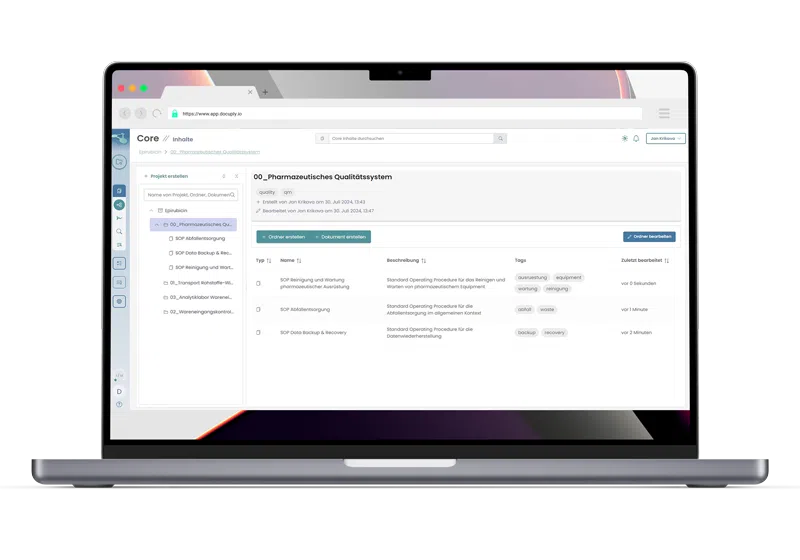
- Docuply: AI-automated eQMS with a fully integrated eTMF (Trial Master File following the CDISC TMF Reference Model; newly approved document versions are linked to the TMF automatically), hosted in the EU, for clinical-stage biotechs and CROs. Public pricing: free eDMS for up to 8 users; EUR 99 (about GBP 85) per user per month for up to 50 users, cancellable monthly, with IQ/OQ, initial vendor qualification and initial training; individual quote above that. Suits seed and Series A biotechs and small CROs that want eQMS and eTMF in one system with predictable costs. Performance qualification (PQ/UAT) for your own intended use remains with the customer, as with any vendor.
Comparison: Veeva Vault and alternatives for small teams (as of November 2026)
| Vendor | eQMS / eTMF | Target segment (per vendor) | Hosting / EU | Stated go-live | Public pricing | Validation documentation |
|---|---|---|---|---|---|---|
| Veeva Vault | both, plus RIM, CTMS and more | pharma from large companies to biotech | AWS; US, Europe (DE, IE), Japan | not publicly available (third-party estimate 3–12 months) | not publicly available | not public in detail; customer validates configuration |
| Qualio | eQMS only | 11–500 employees | AWS; EU-WEST 1 Dublin per third-party source | 30–60 days | not publicly available; implementation fee | not checked in detail |
| MasterControl | both (eTMF as add-on) | start-ups to enterprise | AWS; EU region not publicly named | not publicly available | not publicly available; named-user | Validation Excellence Tool and Validation on Demand included |
| SimplerQMS | eQMS | small teams (up to 15 users on entry plan) | not verified | 5–6 weeks (per SimplerQMS) | from USD 17,500/year for up to 15 users | included in subscription |
| ZenQMS | eQMS | GxP life sciences | not verified | days to weeks | not publicly available | IQ/OQ/PQ documentation per release |
| Scilife | eQMS | life sciences | EU or US data centre selectable | not publicly available | not publicly available | GAMP 5 package included |
| Montrium | both (eTMF Connect, Quality Connect) | organisations under 500 employees | EU or North America included | from 30 days | not publicly available | validation and SOP templates |
| Docuply | both, integrated | clinical-stage biotechs and CROs (focus on organisations of up to 150 employees, scalable to up to 500 employees) | EU cloud | system setup in minutes, productive go-live in 1-3 weeks incl. migration of ~100 documents, incl. Customer Success support | EUR 99/user/month; eDMS free up to 8 users | IQ/OQ included |
What do the FDA and EMA inspect for every system alike?
The FDA and EMA inspect the same things in every system: whether it is validated for its intended use, whether audit trails, access control and electronic signatures work, and whether the company can prove it. No vendor is “Part 11 certified” in a sense you can rely on; responsibility for the validated state lies with the regulated company.
- 21 CFR Part 11 (FDA): requirements for electronic records and signatures, including validation, secure, computer-generated, time-stamped audit trails, access controls and linking of signatures to records. The FDA guidance “Part 11, Electronic Records; Electronic Signatures – Scope and Application” (2003) describes the risk-based approach to validation and audit trails. Details in our guide to 21 CFR Part 11 and electronic signatures.
- EU GMP Annex 11 (EudraLex Volume 4): the current version dates from 2011 and requires, among other things, risk-based validation, supplier agreements, audit trails and periodic evaluation. In July 2025 the European Commission and PIC/S published a fully revised draft (together with a revised Chapter 4 and a new Annex 22 on AI); consultation closed in October 2025. As of November 2026, according to our research, the draft is not yet final. It puts considerably more weight on security, access management, audit trails and the management of suppliers and cloud services.
- ICH E6(R3): the principles and Annex 1 were adopted by ICH in January 2025 and have applied in the EU since 23 July 2025; the FDA published them as final guidance in September 2025. Section 4 (data governance) sets out expectations for computerised systems, including proportionate validation, audit trails, access control and data backup. Requirements for essential records (the TMF) are described in a dedicated appendix.
- EMA guideline on computerised systems and electronic data in clinical trials (EMA/INS/GCP/112288/2023): in effect since September 2023 and explicitly covering cloud solutions. As early as 2020, an EMA notice to sponsors made clear that systems without a confirmed validation status must not be used in clinical trials, regardless of how widely used they are or how long they have been on the market.
- EMA guideline on the trial master file (EMA/INS/GCP/856758/2018): governs the content, management and archiving of the (e)TMF, including system validation, migration and inspector access. Under EU Regulation 536/2014 (Article 58), the TMF must be retained for at least 25 years.
Bottom line: compliance is a question not of brand but of validation and evidence. An enterprise system without a maintained validated state fails an inspection just like any other.
How does switching or a first implementation work, and what are the common mistakes?
An implementation follows six steps: requirements, vendor qualification, validation, migration, training, and go-live with release management. The most common mistakes occur in validation, TMF migration and exit terms.
Steps
- Define requirements: processes (document control, training, deviations/CAPA, change control, suppliers, TMF), user roles including CROs and sites, number of studies, hosting requirements.
- Assess and qualify vendors: demo with your own cases, vendor audit (on site, remote or by questionnaire), review of validation documentation, data processing agreement and sub-processor list.
- Validate: risk assessment, use of vendor documentation (IQ/OQ), your own PQ/UAT for your intended use, validation report and release.
- Migrate: transfer TMF content with metadata and, where possible, audit trail; verify the migration (sampling, completeness reconciliation); bring over QMS records (current SOP versions, training records, open CAPAs); decommission or archive the legacy system in a controlled way.
- Train: role-based, with documented training records before go-live.
- Go live and operate: hypercare phase, release management with an impact assessment for every update, periodic review.
Common mistakes
- Buying more modules than the organisation will use in the next 12–18 months.
- “Delegating” validation entirely to the vendor: vendor IQ/OQ does not replace your own assessment of intended use.
- Migrating the TMF without metadata mapping and without evidence of completeness.
- Filing SOPs and training records twice, in the QMS and the eTMF, with diverging versions.
- Leaving exit terms (data export, format, cost, archiving over 25 years) until the contract ends.
- Relying on a CRO’s eTMF without sponsor oversight: the sponsor remains responsible for the TMF.
Decision guide by segment
- Seed biotech with a first Phase I study (5–20 people): a lean, pre-validated eQMS with an integrated eTMF and predictable costs, or an eTMF-focused system. Key criteria: go-live in weeks, IQ/OQ included, short notice periods, EU hosting.
- Series A biotech running several studies (20–100 people): compare systems that cover eQMS and eTMF on one platform or tightly integrated (e.g. Docuply, MasterControl, Montrium). Compare quotes on total cost over three years (see the TCO guide).
- Small CRO: separation of sponsor studies, easy invitation of external users (sponsors, sites), inspector access and transparent per-user costs matter more than breadth of functionality.
- When Veeva Vault is genuinely the right choice: when scaling towards approval and commercialisation, when running many studies in parallel, when Veeva CTMS, RIM or Safety are already in place, or when partners or a future acquirer expect Veeva.
FAQ
What does Veeva Vault cost for a small team?
Not publicly available. Veeva publishes no list prices; third-party figures are estimates. Ask for a quote showing total cost over three years.
How long does a Veeva Vault implementation take?
Veeva gives no standard duration. Implementation partners estimate 3–6 months for a single application and 6–12 months for a suite.
Is a smaller system a risk in FDA or EMA inspections?
No, provided it is validated and its audit trail, access control, electronic signatures and evidence meet the requirements of Part 11, Annex 11 and ICH E6(R3). Inspectors look at the validated state, not the brand.
Do I need eQMS and eTMF in the same system?
Not necessarily, but it avoids duplicate filing and version mismatches, for example for SOPs, training records and supplier qualifications that are also needed in the TMF.
Where does Veeva Vault host data?
According to Veeva, on AWS in the US, Europe (Germany and Ireland) or Japan; data stays in the chosen region.
Can I move from a lean system to Veeva later?
Yes, as long as the vendor allows a complete export including metadata and audit trail. Clarify the export format and cost before signing.
Sources
- Veeva, cloud infrastructure and data regions: https://www.veeva.com/eu/cloud-infrastructure/
- Veeva 10-K fiscal 2026: https://www.sec.gov/Archives/edgar/data/1393052/000139305226000014/veev-20260131.htm
- Veeva 10-K fiscal 2022: https://www.sec.gov/Archives/edgar/data/1393052/000139305222000017/veev-20220131.htm
- IntuitionLabs, Veeva Vault implementation (third-party estimate): https://intuitionlabs.ai/solutions/veeva-solutions/veeva-vault
- Qualio pricing: https://www.qualio.com/pricing
- Qualio blog (target segment, scope): https://www.qualio.com/blog/regulatory-compliance-management-software
- MasterControl pricing: https://www.mastercontrol.com/pricing/
- MasterControl sub-processors: https://www.mastercontrol.com/privacy/sub-processors/
- SimplerQMS pricing: https://simplerqms.com/pricing/
- ZenQMS pricing: https://www.zenqms.com/qms-software-pricing
- Scilife pricing and hosting: https://www.scilife.io/price
- Montrium pricing: https://www.montrium.com/pricing
- Montrium eTMF Connect: https://info.montrium.com/etmf-system
- Docuply pricing: https://docuply.io/en/pricing/
- Docuply Trial Master File: https://docuply.io/en/trial-master-file/
- eCFR, 21 CFR Part 11: https://www.ecfr.gov/current/title-21/chapter-I/subchapter-A/part-11
- FDA, Part 11 Scope and Application (2003): https://www.fda.gov/regulatory-information/search-fda-guidance-documents/part-11-electronic-records-electronic-signatures-scope-and-application
- FDA, Computer Software Assurance, Federal Register (September 2025): https://public-inspection.federalregister.gov/2025-18468.pdf
- EudraLex Volume 4, Annex 11 (2011): https://health.ec.europa.eu/system/files/2016-11/annex11_01-2011_en_0.pdf
- EMA, ICH E6 Good Clinical Practice: https://www.ema.europa.eu/en/scientific-guidelines/ich-e6-good-clinical-practice
- EMA, Guideline on computerised systems and electronic data in clinical trials: https://www.ema.europa.eu/en/documents/regulatory-procedural-guideline/guideline-computerised-systems-electronic-data-clinical-trials_en.pdf
- EMA, Guideline on the content, management and archiving of the clinical trial master file: https://www.ema.europa.eu/en/documents/scientific-guideline/guideline-content-management-and-archiving-clinical-trial-master-file-paper/electronic_en.pdf

Author: Jan Krikava – A former life science consultant who founded Docuply on the back of his own consulting experience. 14 years of experience in quality management. Business Informatics B. Sc. LinkedIn: linkedin.com/in/jan-krikava