CTMS, EDC or eTMF? Which clinical systems a small sponsor actually needs

Last updated: 26 November 2026
Short answer: a small sponsor does not have to run all three systems itself. In outsourced Phase I/II studies, the CRO usually provides the CTMS (planning and steering of the study, sites, milestones and budget) and the EDC (capture of trial data in eCRFs). Whatever is outsourced, the sponsor remains responsible for the Trial Master File (TMF), for documented oversight of service providers and for a quality system. An eTMF with access to every part of the TMF and an eQMS are therefore often the first systems a sponsor introduces itself. A sponsor-owned CTMS typically pays off only once several studies or service providers run in parallel.
This guide is written for founders, Heads of Clinical Operations and quality leads in biotechs from preclinical to Phase II, and for small and mid-sized CROs.
The three system types and their neighbours at a glance
| System | Purpose | Typical contents | Who uses it | Regulatory basis | Who usually operates it |
|---|---|---|---|---|---|
| CTMS (Clinical Trial Management System) | Planning, steering and monitoring of studies | Sites, countries, milestones, recruitment status, monitoring visits, budgets, site payments | Clinical operations, project management, CRAs | ICH E6(R3) section 4 (data governance, computerised systems); EMA guideline on computerised systems (2023) | The CRO under full-service outsourcing; a sponsor-owned CTMS only with several studies |
| EDC (Electronic Data Capture) | Capturing participants’ clinical data | eCRFs, edit checks, queries, data-point audit trail, data exports | Sites, data management, monitoring, statistics | ICH E6(R3) section 4; EMA guideline 2023; 21 CFR Part 11; FDA guidance on electronic source data (2013) | Usually the CRO or an EDC vendor it selects; the sponsor receives read and export access |
| eTMF (electronic Trial Master File) | Maintaining the TMF with the essential documents of a study | Protocol, Investigator’s Brochure, approvals, contracts, monitoring reports, training records, correspondence | Sponsor, CRO, QA, inspectors (read access) | EU CTR 536/2014 Art. 57/58; ICH E6(R3) Appendix C; EMA TMF guideline EMA/INS/GCP/856758/2018; 21 CFR 312.57 | Sponsor or CRO; responsibility for the sponsor TMF stays with the sponsor |
| eQMS (electronic Quality Management System) | The organisation’s quality system | SOPs, training, deviations, CAPA, change control, audits, supplier and vendor qualification | QA, all staff | ICH E6(R3) section 3 (quality management, oversight of service providers); 21 CFR Part 11 for electronic signatures | Sponsor and CRO, each for its own organisation |
| ISF (Investigator Site File) | The site’s trial file, part of the TMF | Delegation log, signed consent forms, investigator CVs, site correspondence | Site, monitoring | EU CTR Art. 57 (TMF of investigator and sponsor); ICH E6(R3) Appendix C | The investigator site (paper or eISF) |
In short: the CTMS shows where a study stands, the EDC holds what was measured and the eTMF proves how the study was conducted. The eQMS governs the processes under which all three are run. Inspections rely on the TMF. A CTMS status flag does not replace a filed, signed document.
Regulatory framework by system type
| Framework | Status | What it means for the systems |
|---|---|---|
| ICH E6(R3) Good Clinical Practice | ICH Step 4 on 6 January 2025; Principles and Annex 1 effective in the EU since 23 July 2025; Annex 2 effective in the EU from 15 January 2027 | Section 4 (data governance) applies to every computerised system handling trial data, including CTMS, EDC and eTMF. Appendix C describes essential records and requires sponsor and site to record where they are located (C.2.4). Under 3.6.9 the sponsor must ensure appropriate oversight of activities transferred to service providers. |
| FDA guidance E6(R3) Good Clinical Practice | Final guidance September 2025, Federal Register notice of 9 September 2025; non-binding | Adopts the E6(R3) text for the US. FDA regulations (Part 11, Part 312) remain binding. |
| Regulation (EU) No 536/2014 (CTR) | Applicable since 31 January 2022 | Art. 57: sponsor and investigator keep a TMF that “shall at all times contain the essential documents” and is directly accessible to Member States on request. Art. 58: archiving for at least 25 years after the end of the trial; any alteration must be traceable. |
| EMA Guideline on computerised systems and electronic data in clinical trials (EMA/INS/GCP/112288/2023) | Dated 9 March 2023, effective since 9 September 2023 | Explicitly covers systems such as CTMS, eTMF and EDC: validation, user and access management, audit trail, data life cycle. Replaces the 2010 reflection paper on electronic source data. |
| EMA Guideline on the content, management and archiving of the clinical trial master file (EMA/INS/GCP/856758/2018) | Adopted 6 December 2018, effective since June 2019 | Sets expectations for the eTMF: metadata, versioning, search, audit trail, sponsor access to the CRO-maintained part of the TMF and direct read access for inspectors. |
| 21 CFR Part 11 | US law in force | 11.10 requires, among other things, validation (a), limiting access (d), time-stamped audit trails (e) and change control for system documentation (k). Relevant to any system that holds or signs FDA-relevant records electronically. |
| 21 CFR Part 312 | US law in force | 312.50: sponsor responsibilities. 312.52: transfer of obligations to a CRO only in writing; anything not described is deemed not transferred. 312.57: record retention for 2 years after approval or after the investigation is discontinued. |
| FDA Electronic Source Data in Clinical Investigations | Final guidance September 2013 | Covers the capture of electronic source data into eCRFs, so it mainly concerns EDC and eSource. |
| FDA Electronic Systems, Electronic Records, and Electronic Signatures in Clinical Investigations: Q&A | Final on 2 October 2024 (docket FDA-2017-D-1105) | Supersedes the May 2007 guidance “Computerized Systems Used in Clinical Investigations”. Addresses risk-based validation, IT service providers, cloud systems and electronic signatures. |
What a small sponsor needs, and when
The decision depends less on the study phase than on who performs which activity. Under ICH E6(R3) and 21 CFR 312.52, tasks can be transferred to a CRO, but responsibility for trial quality and data integrity stays with the sponsor.
| Starting situation | Typically sits with the CRO | What the sponsor needs itself |
|---|---|---|
| Preclinical, first study in preparation | Nothing yet | eDMS or eQMS for SOPs, training and supplier qualification; selection and qualification records for the future CRO |
| Full-service CRO handles operations and data capture | CTMS, EDC, often the operational eTMF too | eQMS; documented CRO oversight (oversight plan, KPIs, audits); read access to the CRO eTMF; contractually agreed TMF transfer at study close |
| Sponsor maintains the TMF itself | CTMS and EDC | Validated eTMF with TMF plan and index based on the CDISC TMF Reference Model; roles for CRO and site users; eQMS |
| Several studies or CROs in parallel | Study-specific CTMS and EDC instances | A sponsor eTMF as the consolidating layer; portfolio view of milestones (lean CTMS or CTMS module); consistent metadata across providers |
| First inspection or marketing authorisation application in sight | Providing its TMF parts and system evidence | Completeness check against the TMF index; read access for inspectors; system inventory with validation status of every system; archiving concept for 25 years (EU) |
What stays with the sponsor regardless of how much is outsourced: oversight of service providers, a TMF it can access at any time, and a quality system with SOPs, training records, and a deviation and CAPA process. What a CRO has to contribute is covered in eQMS for CROs.
User-friendly TMF management: what matters
In a TMF context, user-friendly means study teams file documents correctly and quickly, and reviewers find them without a guide. In a blog post of 30 July 2015, Gail Francis of the MHRA Inspectorate writes that the inspectorate expects “that we can navigate the TMF ourselves” and that expert users to guide inspectors “should not be necessary following some basic training and an awareness of the eTMF structure”. The same post names record keeping and essential documents as the leading major finding for commercial sponsors, and notes that the MHRA has had to “add extra inspector days” because of problems with TMF access.
- Navigation: structure based on the CDISC TMF Reference Model (version 3.3.1 of 11 August 2023, with 11 zones, 48 sections, 249 artefacts and 607 sub-artefacts from Trial Management to Statistics, per a 2024 CDISC presentation). Benefit: CRO, sponsor and site file the same document in the same place.
- Search and metadata: filters by study, country, site, artefact, version and date. Benefit: audit and inspection requests can be answered in minutes rather than hours.
- Permissions: roles for sponsor, CRO, sites, auditors and a read-only role for inspections. Benefit: external partners collaborate without seeing drafts or other studies.
- Status overviews: expected versus filed documents per milestone, country and site. Benefit: gaps surface during the study, not just before the inspection.
- Completeness checks and QC: risk-based quality checks as set out in the EMA TMF guideline. Benefit: the TMF meets the Art. 57 CTR requirement to be current “at all times”.
TMF oversight across the life cycle means: at study start, the TMF plan, index and responsibilities per artefact are defined. During the study, filing timeliness and completeness are measured. At close-out come reconciliation, transfer of CRO-held parts and archiving. Critical findings in MHRA reports include a hybrid TMF that was not directly accessible and complete (2015/16) and a sponsor TMF that did not sufficiently document oversight of investigator sites (2019/20). A preparation checklist is available in the TMF Inspection Readiness Guide.
Document control for clinical documents
- Review and approval workflows: a defined sequence of authoring, review and approval. Benefit: only reviewed versions of protocol amendments, monitoring plans or SOPs go into circulation.
- Electronic signatures: a uniquely attributed signature with meaning, date and time under 21 CFR Part 11. Benefit: the FDA treats signed records as equivalent to handwritten signatures, and paper routing disappears.
- Audit trail: computer-generated, time-stamped logging of every creation, change and deletion (21 CFR 11.10(e), Art. 58 CTR). Benefit: changes can be reconstructed years later.
- Change control: controlled changes to documents and system configuration with impact assessment. Benefit: an altered template or new workflow does not silently undermine validation.
- Link to training: approval of a new SOP version triggers training tasks. Benefit: the training records ICH E6(R3) expects for trial staff are created in the process rather than retrofitted.
- Periodic review: SOPs and plans come up for review at set intervals. Benefit: outdated instructions are caught before an audit flags them.
- OCR and full-text search: text recognition makes scanned documents searchable and supports mapping them to TMF artefacts. Benefit: retrieval and classification are faster. The mapping still needs human confirmation.
The full GxP requirements for document management are summarised in eDMS requirements for biotechs and CROs.
General-purpose storage or a specialised platform?
Neither option fits every team. The trade-offs at a glance:
| Criterion | General-purpose storage (e.g. SharePoint, file server, cloud drive) | Specialised platform (eTMF, eQMS, CTMS) |
|---|---|---|
| Study-specific structure | Folder structure has to be built and maintained against the TMF Reference Model in-house | Reference Model and metadata often preconfigured; adaptation to study specifics still needed |
| Collaboration with CROs and sites | Guest access possible; permissions per study and role are laborious | Roles for external partners built in; per-user licences can raise costs |
| Access to study records | Familiar to staff, no extra interface | Separate interface requiring onboarding, but with status and completeness views |
| Quality oversight | Completeness only via manual lists | Dashboards of expected versus filed documents, QC workflows |
| Audit capability | Activity logs exist; GxP audit trail and archive lock require configuration | Audit trail and archive functions part of the product; evidence to be requested from the vendor |
| Compliance controls | Part 11 signatures, workflows and validation of own configuration done in-house, maintained with every update | Vendor validation package (e.g. IQ/OQ) reduces effort; PQ and risk assessment remain with the user |
| Inspection preparation | Read access and navigation for inspectors must be prepared separately | Read-only role and exports provided; dependence on the vendor for export and archive |
A validated general-purpose setup can be defensible where few documents are involved, in-house IT or validation capacity exists and no inspection is imminent. The more studies, partners and deadlines are added, the heavier the maintenance burden becomes. The TMF-specific trade-off is covered in detail in SharePoint or eTMF?.
Integrated solution or separate specialised systems?
An eQMS with an integrated eTMF can make sense for small teams running one or a few studies, where the same people are responsible for quality and clinical operations. The case rests on fewer systems, one validation, one permission concept and direct links: an approved SOP, its training record and the corresponding TMF artefact are not held several times in separate repositories.
Separate specialised systems often fit better when many studies run in parallel, when large data volumes and complex integrations are involved (for example CTMS-EDC interfaces for recruitment and site payments), or when the CRO’s systems are contractually fixed. An integrated system also does not replace an EDC: data capture remains a separate, separately validated system that can be connected via interfaces. The vendors are compared in the eTMF software comparison 2026.
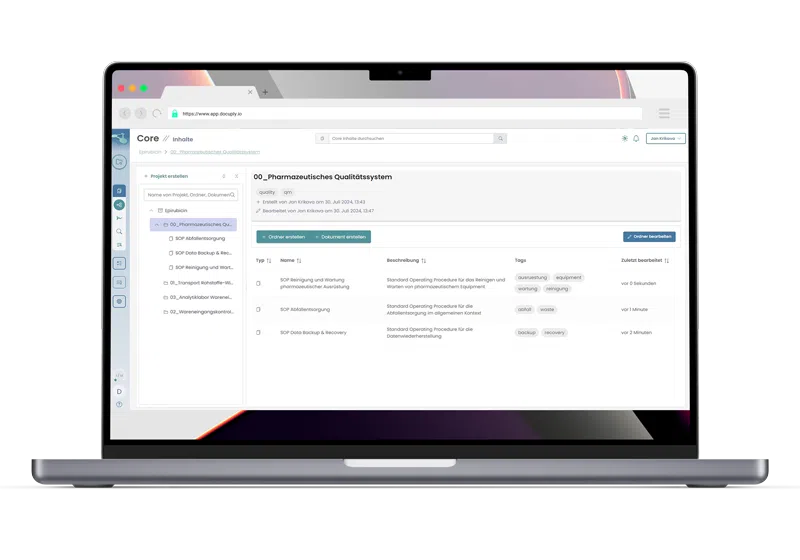
Docuply is an AI-automated eQMS with a fully integrated eTMF based on the CDISC TMF Reference Model, for clinical-stage biotechs and small CROs. Whether this approach fits depends on the starting situation described above.
Frequently asked questions
What is the difference between CTMS, EDC and eTMF?
The CTMS steers the study (sites, milestones, monitoring, budget), the EDC captures participants’ clinical data in eCRFs, and the eTMF holds the essential documents that inspections examine. The three systems complement each other; none replaces another.
Does a small biotech need a CTMS?
For a single study outsourced to a full-service CRO, often not, because the CRO uses its own CTMS and reports to the sponsor. A sponsor-owned CTMS becomes relevant when several studies or CROs are managed in parallel.
Can SharePoint be used for clinical trial documents?
Yes, if structure, permissions, Part 11 signatures, audit trail and validation of the organisation’s own configuration are built and maintained in-house. Without that work SharePoint is not a GxP system. For the TMF, completeness tracking and inspector access come on top.
What should a user-friendly TMF system include?
Navigation based on the CDISC TMF Reference Model, search across metadata and full text, roles for CRO, sites and inspectors, status overviews per milestone, country and site, and completeness checks with a QC workflow.
Which clinical systems does the CRO usually provide?
Under full-service contracts, typically the CTMS and EDC, and often the operational eTMF. The sponsor remains responsible for the TMF, oversight and the quality system, and should secure contractual access to every part of the TMF.
What are the trade-offs between general-purpose storage and specialised clinical trial platforms?
General-purpose storage is inexpensive and familiar, but shifts structure, GxP controls and validation to the in-house team. Specialised platforms bring these functions, but cost licence fees and create vendor dependence. Which option fits depends on the number of studies, partners and how close an inspection is.
Sources
- ICH E6(R3) Guideline for Good Clinical Practice, Step 4, 6 January 2025
- EMA: ICH E6(R3) Step 5 (EMA/CHMP/ICH/135/1995)
- FDA: E6(R3) Good Clinical Practice, final guidance September 2025
- Regulation (EU) No 536/2014, Articles 57 and 58
- EMA: Guideline on computerised systems and electronic data in clinical trials (EMA/INS/GCP/112288/2023)
- EMA: Guideline on the content, management and archiving of the clinical trial master file (EMA/INS/GCP/856758/2018)
- 21 CFR Part 11
- 21 CFR Part 312, Subpart D
- FDA: Electronic Source Data in Clinical Investigations (September 2013)
- FDA: Electronic Systems, Electronic Records, and Electronic Signatures in Clinical Investigations: Q&A (October 2024)
- CDISC: Trial Master File Reference Model
- MHRA: GCP Inspection Metrics 2019–2020
- MHRA Inspectorate Blog: Inspecting clinical trials – the trial master file

Author: Jan Krikava – A former life science consultant who founded Docuply on the back of his own consulting experience. 14 years of experience in quality management. Business Informatics B. Sc. LinkedIn: linkedin.com/in/jan-krikava