Part 11 e-signature software for clinical trials: standalone signature apps or signatures inside your eQMS and eTMF?

Last updated: 27 November 2026
Educational guide, not legal advice.
Short answer: A general e-signature app with a Part 11 add-on can be enough for contracts, CDAs, budgets and vendor agreements. It adds risk for GxP records that have to stay controlled after signing. These include SOP approvals, training sign-offs, TMF artefacts, deviations and CAPAs, and eCRF sign-off. For those records the signature must stay linked to the controlled version, its audit trail and its filing location. No tool makes you “Part 11 compliant”. The FDA states that it “does not certify electronic systems and methods used to obtain electronic signatures”. Compliance depends on how you configure the tool, validate it for its intended use, run it under SOPs and control accounts, and on your letter of non-repudiation to the FDA. For many small sponsors and CROs the realistic setup is a combination: an app for agreements, and signatures inside the eQMS, eTMF and EDC for GxP records.
This page answers one question: which signature tool fits which clinical document, and where does a standalone app stop being enough? The requirements in depth and a vendor comparison of eQMS systems are covered in our 21 CFR Part 11 electronic signatures guide.
Signature tool types at a glance
| Tool type | Typical use | Part 11 features (as stated by the vendor) | What the customer still has to do | Where signed records live | Typical cost model |
|---|---|---|---|---|---|
| General e-signature app, standard plan (DocuSign eSignature, Adobe Acrobat Sign, Signeasy, PandaDoc, Dropbox Sign) | Contracts, NDAs/CDAs, HR and vendor paperwork | Usually none. Dropbox states that Dropbox and Dropbox Sign “do not offer compliance support under 21 CFR Part 11 specific to electronic signatures”. | Treat the output as a non-GxP record, or keep wet-ink or other controls for GxP use | In the vendor’s cloud, plus PDFs you export to your own storage | Per seat or per envelope; public price lists |
| Same app with a Part 11 module or configuration | Contracts plus selected regulated sign-offs, especially with external signers | DocuSign: Part 11 module with signature-level authentication, reason for signing and signature manifestation, plus Validator for Life Sciences and SMS authentication (Life Sciences package). Adobe Acrobat Sign: “Bio-Pharma Settings”, identity authentication and signing reasons, and a handbook for 21 CFR Part 11 and Annex 11. Signeasy: Part 11 controls on a custom plan; states that “full compliance also depends on your internal procedures and validation efforts”. PandaDoc: dedicated “21 CFR Part 11–ready workspaces” since October 2025, with signature manifestation and template-level identity verification. | Risk-based validation (URS, testing, vendor assessment), SOPs for signing and account management, identity verification before issuing signatures, training, the §11.100(c) letter, and filing the signed PDF in your controlled system | Vendor cloud (envelope and audit certificate) plus an exported PDF that has to be filed in your eTMF or eQMS | Add-on to business or enterprise tiers, usually through sales. PandaDoc states a $650 annual fee per Part 11 workspace on Enterprise plans plus a per-document fee. Signeasy uses a custom quote. Public DocuSign and Adobe list prices could not be verified. |
| Clinical-specific signature, eConsent and eISF tools (e.g. Viedoc eSignature/eConsent, Florence eBinders and eConsent, Medable Total Consent) | Participant consent, site regulatory binders, delegation logs, investigator signatures on site documents | Viedoc states Part 11 eSignature embedded across its EDC, eTMF and participant app. Florence states its eBinders e-signatures are Part 11 compliant, and sites receive a compliance memo, audit certificate and SOP templates. | Site or sponsor validation review, IRB/EC approval of the eConsent materials, site SOPs, local checks on whether the signature type is acceptable | In the clinical platform (eISF or EDC), close to the trial context | Per study, per site or enterprise licence; mostly by quote |
| Signatures built into an eQMS, eTMF or EDC | SOP and controlled-document approvals, training records, deviations/CAPA, change control, TMF QC, eCRF sign-off | Part of the validated system: manifestation, re-authentication at signing, audit trail on the record itself | Validation of the whole system for its intended use, user and role management, SOPs, the §11.100(c) letter. External signers usually need guest accounts or a workflow. | On the controlled record, its version and its audit trail | Part of the system subscription (per user, per module or per study) |
What 21 CFR Part 11 actually requires for electronic signatures
Part 11 has applied since 20 August 1997. Its signature rules sit in Subpart B (records) and Subpart C (signatures):
- §11.10 (system controls): validation to ensure accuracy and reliability and the ability to detect invalid or altered records (11.10(a)). It also requires secure, computer-generated, time-stamped audit trails (11.10(e)), limited system access (11.10(d)), authority checks (11.10(g)), trained users (11.10(i)) and written policies that hold people accountable for actions under their signatures (11.10(j)).
- §11.50 (signature manifestation): signed records must show the printed name of the signer, the date and time of signing, and the meaning of the signature (for example review, approval, responsibility or authorship), including on screen and in printouts.
- §11.70 (signature/record linking): signatures must be linked to their records so they “cannot be excised, copied, or otherwise transferred to falsify an electronic record by ordinary means”.
- §11.100 (general requirements): each signature is unique to one person and never reused or reassigned (a). The organisation verifies the person’s identity before issuing the signature (b). The organisation certifies to the FDA that its electronic signatures are the legally binding equivalent of handwritten signatures (c).
- §11.200 (components and controls): non-biometric signatures use at least two distinct components, such as a user ID and a password. In one continuous session the first signing uses all components and later signings use at least one private component. Biometric signatures must be usable only by their genuine owner.
- §11.300 (ID codes and passwords): no two people share the same combination. Credentials are checked and revised periodically. Lost credentials are deactivated. Safeguards detect and report attempted misuse.
How the FDA reads Part 11 today
2003 guidance “Part 11, Electronic Records; Electronic Signatures – Scope and Application”: the FDA interprets Part 11 narrowly. It applies to records required by a predicate rule (for example 21 CFR 312 for INDs) or submitted to the FDA. The FDA said it would use enforcement discretion on validation, audit trails, record retention and copying, but not on the signature controls. The predicate rules are enforced in full.
October 2024 final Q&A “Electronic Systems, Electronic Records, and Electronic Signatures in Clinical Investigations” (docket FDA-2017-D-1105, announced in the Federal Register on 2 October 2024; it supersedes the 2007 computerised systems guidance). The points relevant to signatures:
- Q24: Part 11 “do[es] not specify a particular method to create a valid electronic signature”. Examples include ID cards, biometrics, digital signatures and username/password combinations. For off-the-shelf e-signature services, “regulated entities should ensure that these services conform to part 11 requirements based on information from the … service providers or their own validation of the services when warranted”.
- Q25: signatures drawn with a finger or stylus are treated as handwritten signatures executed to an electronic record. They still have to be linked to that record.
- Q26: identity can be verified with, for example, government-issued ID, security questions, or strong digital credentials with multi-factor authentication or video observation.
- Q7 and Q16: validation should be risk-based (intended use, importance of the data, impact on participants and results). FDA does not pre-evaluate systems; they are assessed at inspection.
- Section C (IT service providers): sponsors stay responsible for Part 11 compliance. They should assess the provider’s validation, access controls, audit trails, e-signature controls and record retention, and put this in a written agreement.
- Q28: the FDA does not certify systems. Q29: a letter of non-repudiation is required, and one letter per organisation can cover all its signatures.
The key point: a vendor cannot make you Part 11 compliant
Pages titled “Part 11 compliant e-signature” describe technical controls. What an inspector checks is the system as you operate it. That includes the validation records, how accounts were set up, who verified identities, whether the signing reason was mandatory, whether the signed record was filed and QC’d, and whether your organisation has sent the non-repudiation letter. The FDA puts it plainly: it would consider signatures trustworthy if they meet Part 11 “regardless of the particular technology or brand used” (Q28). EMA guidance says the same about validation. The responsible party “remains ultimately responsible for the validation of the computerised systems used in clinical trials”, even when it relies on vendor documentation.
Read vendor pages accordingly. DocuSign states its modules “support your compliance”. Adobe’s handbook describes settings “tied to meeting” Part 11 requirements. Signeasy says compliance “also depends on your internal procedures and validation efforts”. PandaDoc describes signatures executed “as part of validated, compliant processes”. All of these are vendor claims. None of them is regulatory approval.
EU and UK view
- EMA Guideline on computerised systems and electronic data in clinical trials (EMA/INS/GCP/112288/2023): published 9 March 2023 and in effect since September 2023 (six months after publication). Section 4.8 requires e-signature functionality to ensure authentication, non-repudiation, an “unbreakable link” between record and signature, and a timestamp with time zone. In closed systems (where the system owner knows all signers, “the majority of systems used in clinical trials”), eIDAS does not apply (eIDAS Art. 2(2)) and the functionality should be proven during validation. In open systems, signatures at EU sites “should meet the requirements defined in the ‘eIDAS’ regulation”. The guideline also expects investigator sign-off of eCRF data at risk-based milestones, not one batch signature before database lock (section 6.3).
- eIDAS (Regulation (EU) 910/2014, amended by 2024/1183, in force since 20 May 2024): defines simple, advanced and qualified electronic signatures. Art. 25: no signature may be denied legal effect solely because it is electronic or not qualified, and only a qualified electronic signature (QES) has the equivalent legal effect of a handwritten signature. eIDAS does not require a QES for clinical documents in general.
- EU GMP Annex 11: the 2011 text is still in force. A draft revision was published on 7 July 2025 and consultation closed on 7 October 2025. As of November 2026 the Commission had not adopted a final text or set a date of application (according to several industry trackers; check the EudraLex Volume 4 page before publishing).
- ICH E6(R3): the principles and Annex 1 have applied in the EU since 23 July 2025. The FDA issued them as final guidance in September 2025. Annex 2 has an EU legal effective date of 15 January 2027. E6(R3) asks for computerised systems that are fit for purpose and validated in proportion to risk, rather than prescribing a signature technology.
- eConsent in the EU: the Recommendation paper on decentralised elements in clinical trials (version 1 of 13 December 2022, version 2 of 1 October 2025, published 29 October 2025) leaves the signature type to national law. Its appendix shows a patchwork: some member states require a QES for the consent form, and others accept advanced or qualified signatures.
- UK: the amended Medicines for Human Use (Clinical Trials) Regulations came into force on 28 April 2026, and ICH E6(R3) took effect in the UK on the same date. MHRA’s GxP Data Integrity Guidance (2018) expects e-signatures to be attributable, secured and validated, with signature manifestation. It says the use of advanced electronic signatures “should be considered where … required by the risk assessment”, and that a pasted signature image “is not adequate”. The HRA/MHRA joint statement on eConsent (2018) allows simple electronic signatures, scaled to trial risk.
Decision guide by document type
| Document | Standalone app enough? | Why |
|---|---|---|
| CDAs/NDAs, clinical trial agreements, budgets, vendor and CRO contracts | Usually yes | These are commercial agreements, generally outside predicate-rule signature requirements. The signed PDF is filed in the TMF as a final document. Speed and familiarity for external parties matter most. |
| Some regulatory correspondence, cover letters | Often yes, with a Part 11 configuration if the record is submitted to the FDA | Records submitted to the FDA fall within Part 11 scope. Configure manifestation, signing reason and authentication, then file the record in the TMF. |
| SOP and controlled-document approvals | Adds risk | The approval belongs to a specific version, the effective date and the training trigger. An exported PDF breaks the link to version history and the document’s audit trail, so you end up keeping two records. |
| Training sign-offs | Adds risk | Training records must tie a person to an SOP version. App envelopes scatter evidence across systems at inspection. |
| Protocol and amendment sign-off (sponsor, investigator signature pages) | Possible, but it creates filing and QC work | External investigators often prefer an app. Every signed page then has to be filed, indexed and QC’d in the eTMF, and the link to the protocol version must be shown. |
| Investigator signatures on site documents (delegation log, 1572, CVs) | Better in an eISF or clinical tool | Site records sit under the investigator’s control. EMA expects the investigator to keep control and access. |
| eCRF/CRF sign-off | No: sign in the EDC | Sign-off confirms specific data points at defined milestones, so it must live in the EDC with its audit trail. |
| Deviations, CAPA, change control | Adds risk | Approvals are workflow steps on a living record. A PDF signature cannot show the state of the record at the time of signing. |
| Informed consent | Separate category (eConsent) | See below. |
The underlying reason: under §11.70 and EMA section 4.8 the signature must stay tied to the record. An app gives you a sealed PDF plus a certificate of completion. That is valid, but it is disconnected from the controlled record, its version history and its audit trail. Someone then has to file it, QC it and reconcile it in the TMF or QMS. For more on document-control expectations, see eDMS requirements for biotechs and CROs.
Where eConsent fits
eConsent uses electronic systems, often with video, quizzes or audio, to inform participants and document their consent. It is a separate category from staff e-signatures. It involves verifying the identity of members of the public, checking comprehension, getting IRB/EC approval of every screen and version, handling re-consent and giving participants a copy, all inside the site workflow. The FDA/OHRP joint guidance “Use of Electronic Informed Consent – Questions and Answers” (December 2016) applies 21 CFR Parts 11, 50 and 56. It remains the dedicated FDA eConsent guidance. A 2024 FDA/OHRP draft on key information in consent forms is a draft only. In the EU, the DCT recommendation paper and national provisions apply. In the UK, the 2018 HRA/MHRA joint statement applies.
Trade-offs: standalone app versus built-in signatures
| Factor | Standalone app (with Part 11 module) | Built into eQMS/eTMF/EDC |
|---|---|---|
| Cost | Low for basic plans; Part 11 add-ons usually quote-based | Included in the system subscription |
| Speed of setup | Fast | Tied to system implementation |
| External signers | Familiar, no account needed | Need guest access or a workflow |
| Validation effort | A separate system to validate | Covered by validating the main system |
| Number of systems | One more | Fewer |
| Audit-trail continuity | Split between the app and the filing system | On the record |
| Inspection retrieval | Envelope plus PDF plus filing | One place |
Neither option wins outright. A common, defensible setup is an app for agreements and built-in signatures for GxP records. See eQMS Software Compared 2026, eTMF Software Comparison 2026 and CTMS, EDC or eTMF?
Where Docuply fits
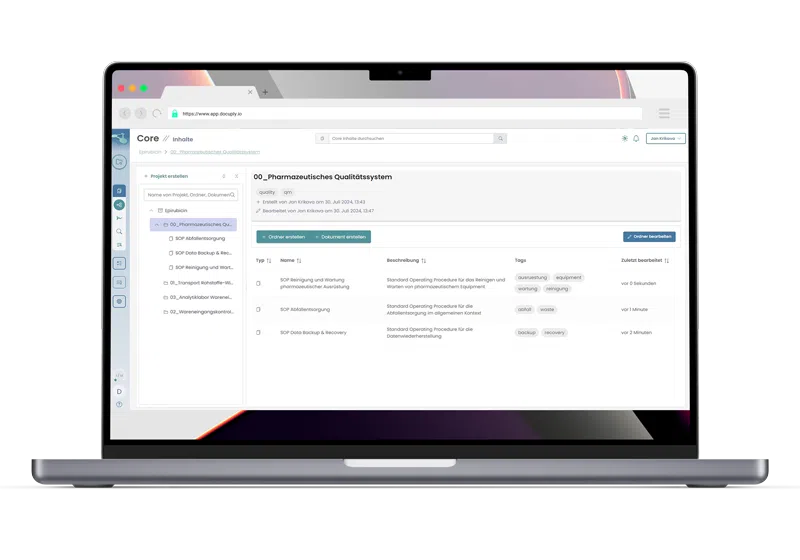
Docuply is an AI-automated eQMS with an integrated eTMF and Part 11 e-signatures. It covers the GxP side of this split: SOP approvals, training, quality events and TMF documents signed on the controlled record. It does not replace eConsent or EDC sign-off. Many teams will keep a contract-signing app for agreements, and the same rules on validation, SOPs and the non-repudiation letter apply.
FAQ
Is DocuSign 21 CFR Part 11 compliant?
No software is Part 11 compliant on its own, and the FDA does not certify systems. DocuSign offers Part 11 features through its Life Sciences/Part 11 module, including signature-level authentication, signing reasons, signature manifestation and a validation tool. You still need to validate it, write SOPs, control accounts and send the FDA a letter of non-repudiation.
Can I use Adobe Sign for clinical trial documents?
Yes for agreements and many other documents. For records under Part 11, Adobe states that its Bio-Pharma Settings support Part 11 requirements. You must configure, validate and file the signed records yourself. For SOP, training, TMF and eCRF sign-offs, signing inside the controlled system is usually lower risk.
What e-signature software meets FDA requirements for clinical trials?
The FDA does not approve software. A tool can meet FDA expectations when its Part 11 features (manifestation, record linking, unique two-component signatures, audit trail) are configured, validated for your intended use and run under SOPs. Options include e-signature apps with Part 11 modules, clinical eConsent and eISF tools, and signatures built into an eQMS, eTMF or EDC.
Do I need a Part 11 compliant e-signature for SOP approvals and training records?
If you keep these GxP records electronically and sign them electronically, Part 11 applies to the signatures. Signatures inside a validated eQMS keep the approval tied to the SOP version and its training records.
What is the difference between eConsent and e-signatures?
An e-signature is a way of signing a record. eConsent is the whole informed consent process done electronically: information, comprehension checks, IRB/EC-approved content, participant identity, signature and a copy for the participant, under 21 CFR 50 and the FDA/OHRP 2016 guidance.
Are qualified electronic signatures (eIDAS) required for clinical trial documents in the EU?
Not in general. The EMA guideline says eIDAS does not apply to closed systems, where validation must prove the signature controls. Open systems at EU sites should meet eIDAS. For informed consent, several member states require a qualified or advanced signature, so check national provisions.
Do I need to send a letter to the FDA before using electronic signatures?
Yes. Under 21 CFR 11.100(c), before or at the time of first use, you send the FDA a letter certifying that your electronic signatures are the legally binding equivalent of handwritten signatures. One letter can cover the whole organisation.
Sources
- 21 CFR Part 11 (eCFR): https://www.ecfr.gov/current/title-21/chapter-I/subchapter-A/part-11
- FDA, Part 11 Scope and Application (2003): https://www.fda.gov/regulatory-information/search-fda-guidance-documents/part-11-electronic-records-electronic-signatures-scope-and-application
- FDA, Electronic Systems, Records and Signatures in Clinical Investigations Q&A (Oct 2024): https://www.fda.gov/media/166215/download
- FDA/OHRP, Use of Electronic Informed Consent Q&A (Dec 2016): https://www.fda.gov/media/116850/download
- EMA/INS/GCP/112288/2023: https://www.ema.europa.eu/en/documents/regulatory-procedural-guideline/guideline-computerised-systems-and-electronic-data-clinical-trials_en.pdf
- EMA, ICH E6 page: https://www.ema.europa.eu/en/ich-e6-good-clinical-practice-scientific-guideline
- EC DCT recommendation paper v2 (Oct 2025): https://health.ec.europa.eu/document/download/2ccc46bf-2739-4b9a-ab6b-6f425db78c61_en?filename=mp_decentralised-elements_clinical-trials_rec_en.pdf
- Regulation (EU) 2024/1183: https://eur-lex.europa.eu/eli/reg/2024/1183/oj/eng
- MHRA GxP Data Integrity Guidance (2018): https://assets.publishing.service.gov.uk/media/5aa2b9ede5274a3e391e37f3/MHRA_GxP_data_integrity_guide_March_edited_Final.pdf
- HRA/MHRA eConsent statement (2018): https://s3.eu-west-2.amazonaws.com/www.hra.nhs.uk/media/documents/hra-mhra-econsent-statement-sept-18.pdf
- MHRA clinical trials hub: https://www.gov.uk/government/collections/medicines-clinical-trials
- DocuSign Life Sciences Modules: https://www.docusign.com/products/life-sciences-modules
- Adobe Acrobat Sign Part 11 handbook: https://www.adobe.com/cc-shared/assets/pdf/trust/acrobat-sign-handbook-for-fda-regulated-organizations.pdf
- Signeasy Part 11: https://pages.signeasy.com/21-cfr-part-11-compliance
- PandaDoc Part 11: https://www.pandadoc.com/cfr-part-11-esignature/
- PandaDoc, Build 21 CFR Part 11 compliant workflows: https://support.pandadoc.com/en/articles/12859094-build-21-cfr-part-11-compliant-workflows-using-pandadoc
- Dropbox and 21 CFR Part 11: https://help.dropbox.com/security/fda-21-cfr-part-11
- Viedoc buyer’s guide: https://www.viedoc.com/buyers-guides/best-econsent-esignature-software-clinical-trials
- Florence eBinders FAQ: https://www.florencehc.com/florence-ebinders-faq/

Author: Jan Krikava – A former life science consultant who founded Docuply on the back of his own consulting experience. 14 years of experience in quality management. Business Informatics B. Sc. LinkedIn: linkedin.com/in/jan-krikava