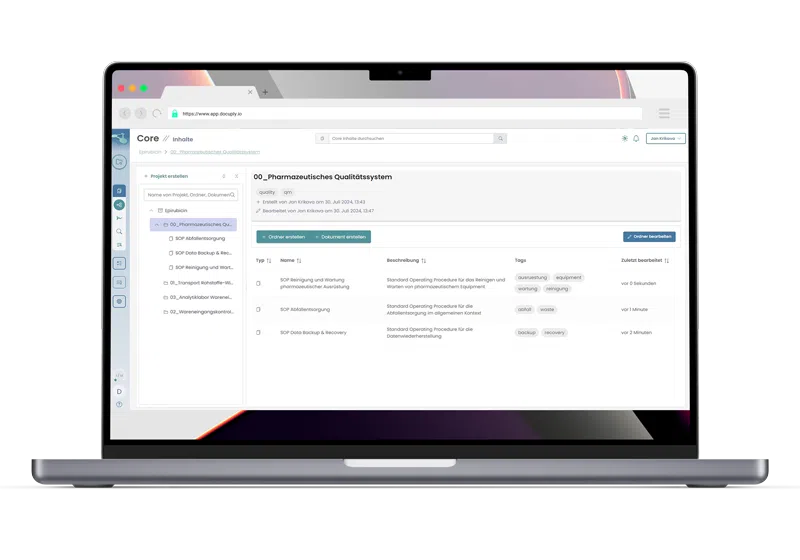
AI in the eQMS: What Artificial Intelligence May Do in GxP Quality Management and How Biotechs Can Use It Safely

Last updated: 5 November 2026
AI may be used in GxP quality management provided it is validated for a clearly defined purpose on a risk basis, its outputs are traceable and a qualified person remains in control. No regulation prohibits AI in an eQMS. What matters is how strongly an AI output affects patient safety, product quality and data integrity, and who makes the final decision. The framework is set by the EU AI Act (Regulation (EU) 2024/1689), draft EU GMP Annex 22 and the draft revision of Annex 11, the EMA reflection paper on AI, ICH E6(R3), the EMA guideline on computerised systems in clinical trials, 21 CFR Part 11 and FDA guidance on computer software assurance and AI. For small biotechs and CROs, the practical consequence is to treat AI as a source of suggestions with documented approval, keep model versions under change control and protect sponsor data by contract. This guide, published by Docuply, sets out use cases, regulation, validation, risks and selection criteria.
AI use cases in the eQMS: benefit, GxP risk and required control (as of November 2026)
| Use case | Benefit | GxP risk | Required control |
|---|---|---|---|
| Document classification and metadata extraction (e.g. TMF filing against the TMF Reference Model) | Less manual indexing, faster filing of high document volumes | Medium: misfiling and wrong metadata undermine completeness and retrievability (data integrity) | Human in the loop with a confidence threshold, sample QC, precision and recall monitored per document type |
| OCR and semantic search | Faster retrieval, including scanned records | Low, as long as the original document remains authoritative | Check against the original where used for GxP purposes, periodic sampling of result quality |
| SOP drafting and version comparison | Quicker first drafts, clear change summaries | Medium: errors in an approved SOP propagate to every downstream process | Expert review and the usual four-eyes approval in document control, AI contribution labelled |
| Summaries (audit and monitoring reports, regulations) | Rapid overview of long documents | Medium: omissions and hallucinations are possible | Reading aid only, source references in the output, decisions based on the original |
| Deviations and CAPA (root-cause suggestions, trend analysis) | Spotting patterns across many records, earlier detection of recurrence | High where root-cause assessment or risk rating is adopted unchecked (product quality, patient safety) | AI as a source of hypotheses only, assessment and approval by QA, trends verified against raw data |
| Training and comprehension questions | Fast creation of knowledge checks for new SOPs | Low to medium: flawed questions weaken evidence of training effectiveness | Expert approval of the question pool before use |
| Audit and inspection preparation (gap analyses, document lists) | Earlier identification of gaps and overdue documents | Medium: incorrect completeness statements create false assurance | Results checked against system reports and the audit trail, no unverified AI statement given to inspectors |
Which AI features in an eQMS are worthwhile, and how risky are they?
The most useful AI features pre-sort large document volumes or make them searchable, with a person reviewing the result anyway: classification, metadata extraction and semantic search. The more directly an AI output feeds a GxP decision, such as the assessment of a deviation, the higher the risk and the stricter the control must be.
The yardstick comes from draft Annex 22 (consultation version, July 2025): critical applications are those with a direct impact on patient safety, product quality or data integrity. Where generative models are used in non-critical applications, the draft requires qualified staff to remain responsible for the suitability of every output (human in the loop). The EMA reflection paper (September 2024) and the ISPE GAMP Guide: Artificial Intelligence (July 2025) take the same line: risk-based, human-centred and governed by quality risk management across the lifecycle.
Inspection data show why document quality is not a side issue. In the EMA GCP Inspectors Working Group annual report for 2024 (adopted December 2025), 41 of the 335 critical and major findings from 67 inspections concerned “Essential Documents”, the largest single category. The 2023 report (EMA/INS/GCP/164938/2024) recorded 74 of a total of 720 findings (36 critical, 336 major, 348 minor) in the same category, again the highest.
There are, as yet, no robust independent figures on time saved in TMF filing or CAPA handling; published numbers come almost entirely from vendors and have not been independently verified. A study by Gray, Xu, Tong and Wu at the FDA National Center for Toxicological Research (Chemical Research in Toxicology, July 2023) on AI classification of regulatory text also shows how much accuracy depends on document type: 95% for standardised US labelling in a binary task, but only 68% for UK SmPCs in a multi-class task according to the abstract (0.67 in the model comparison table). Vendor accuracy claims should therefore always be tested on your own documents. For the technical side of text recognition, see OCR and intelligent document search.
Does an eQMS with AI fall under the EU AI Act?
Usually not as a high-risk system: AI features for document control, search or CAPA support are not listed in Annex III of the AI Act and are not a safety component of a product under Annex I. Obligations still apply, because an organisation using AI in its operations is a deployer and has been required since 2 February 2025 to promote AI literacy among its staff.
Regulation (EU) 2024/1689 entered into force on 1 August 2024. Prohibitions and the Article 4 AI literacy duty have applied since 2 February 2025, and obligations for providers of general-purpose AI models since 2 August 2025. The Digital Omnibus on AI (Regulation (EU) 2026/1744), in force since 27 July 2026, moves the Annex III high-risk obligations to 2 December 2027 and those under Article 6(1) with Annex I to 2 August 2028. Article 4 has been recast as a duty of effort: providers and deployers must take measures to support AI literacy without having to guarantee any specific level.
The case against high-risk classification: Annex III covers areas such as employment, education, critical infrastructure and access to essential services, but not quality management. An eQMS is not a medical device, and Article 6(3) expressly excludes systems performing narrow procedural tasks.
The case for a closer look: if AI outputs are used to evaluate the performance or behaviour of staff, for example automatically scored training tests feeding qualification or HR decisions, Annex III point 4 (employment) may be engaged. Manufacturers of medical device software face separate rules for those products. In addition, Article 50 transparency obligations apply from 2 August 2026, chiefly to providers of generative systems.
Conclusion: for a Phase I/II biotech or a small CRO, an eQMS with AI is typically not a high-risk system. What is required is documented AI literacy measures, use in line with the provider’s instructions and a short, reasoned classification for each AI feature. The real compliance bar is set by GxP rules, not by the AI Act.
What does Annex 22 cover, and what changes with the new Annex 11?
Annex 22 “Artificial Intelligence” is a draft addition to the EU GMP Guide that was open for consultation from 7 July to 7 October 2025 and, as of November 2026, has not been adopted. It applies to AI models in critical GMP applications and admits only static, deterministic models there; dynamic, probabilistic and generative models, including LLMs, should not be used in critical applications.
The core requirements of draft Annex 22:
- Intended use: a detailed description of the task and the input sample space, including rare variations, owned by a process expert and approved before testing begins.
- Acceptance criteria: predefined metrics such as a confusion matrix, sensitivity, specificity, precision or F1 score; the model must perform at least as well as the process it replaces.
- Test data: representative, sufficiently large, correctly labelled and strictly independent of training and validation data, protected by access control and an audit trail.
- Explainability and confidence: recording the features that drove a decision, logging confidence scores and setting a threshold below which the model reports “undecided”.
- Operation: change and configuration control, performance monitoring and monitoring of input data for drift.
- Human in the loop: where testing effort is reduced on the strength of human review, the reviewer’s responsibility, training and performance must be described and monitored.
The scope may still change. According to the EMA report on the expert workshop of 30 June and 1 July 2026 (published October 2026), the drafting group has discussed admitting dynamic, probabilistic and generative models where a fully documented, risk-based control strategy is in place. No date for the final text has been confirmed.
The draft revision of Annex 11, consulted on in the same package (also a draft, July 2025), makes audit trails the norm for systems in which users create, modify or delete data, requires risk-based audit trail review by people not involved in the activity, governs service providers including cloud and SaaS vendors, and turns periodic review into a programme in its own right. GMP responsibility remains with the regulated company.
Neither annex is directly binding in the GCP setting. Both, however, describe what European inspectorates expect of AI in critical applications, which makes them a sensible reference for small biotechs too.
What do the EMA, ICH and FDA expect of AI in trials and quality systems?
The EMA, ICH and FDA consistently require a risk-based approach: computerised systems must be validated for their purpose, data must remain traceable through an audit trail, and the sponsor stays responsible for outsourced activities. AI-specific guidance adds context of use, model influence and lifecycle monitoring.
Regulatory framework at a glance (as of November 2026)
| Instrument | Status and date | Relevance to an eQMS with AI |
|---|---|---|
| EU AI Act (EU) 2024/1689 | In force since 1 August 2024; amended by the Digital Omnibus (EU) 2026/1744, in force since 27 July 2026 | Usually not high-risk; check AI literacy (Art. 4) and transparency |
| EU GMP Annex 22 (AI) | Draft, consultation 7 July to 7 October 2025; not adopted | Reference for validating and operating AI models in critical applications |
| EU GMP Annex 11 (revised) | Draft since July 2025; the 2011 Annex 11 remains in force | Audit trail, oversight of service and cloud providers, periodic review |
| EMA reflection paper on AI | Final, adopted September 2024 (CHMP/CVMP) | Risk-based, human-centred approach across the lifecycle |
| EMA guideline on computerised systems in clinical trials | Final, published March 2023, applicable since September 2023 | Validation, audit trail, responsibilities of service providers |
| ICH E6(R3) | ICH Step 4 on 6 January 2025; effective in the EU since 23 July 2025; Annex 2 from 15 January 2027 | Risk-proportionate validation, data integrity, sponsor responsibility |
| FDA draft guidance on AI for regulatory decision-making | Draft, January 2025; not finalised according to available information | Transferable principles: context of use, model influence, decision consequence |
| FDA Computer Software Assurance | Final, published 24 September 2025 | Risk-based assurance rather than blanket test scripts |
| 21 CFR Part 11 | In force (US regulation since 1997) | Audit trail and electronic signatures for approving AI suggestions |
The EMA reflection paper, adopted by the CHMP and CVMP in September 2024, calls for risk-based, human-centred use of AI throughout the medicinal product lifecycle. In clinical trials, AI applications are subject to GCP, and where AI has a high impact on regulatory decisions the EMA recommends early dialogue with the agency.
The EMA guideline on computerised systems and electronic data in clinical trials (March 2023) requires a secure, computer-generated, time-stamped audit trail for the creation and modification of all electronic data, risk-based audit trail review and validation evidence that can be made available to inspectors. The tasks and responsibilities of service providers must be set out in contracts.
Section 4.3 of ICH E6(R3) requires computerised systems to be validated in proportion to risk, interfaces to be defined and validated, and systems to be reviewed periodically. The sponsor keeps a record of important systems and remains responsible for tasks transferred to service providers.
The FDA draft guidance of January 2025 sets out a seven-step credibility assessment: define the question and the context of use, derive model risk from model influence and decision consequence, then plan and document evidence in proportion to that risk. It targets AI that produces data for regulatory decisions on safety, effectiveness or quality, not efficiency support within a QMS. The logic still transfers: the greater the AI’s influence and the graver the consequence of an error, the more evidence is needed. The joint, non-binding FDA and EMA Guiding Principles of Good AI Practice (January 2026) follow the same line.
The final FDA guidance on Computer Software Assurance (24 September 2025) formally covers production and quality system software at medical device manufacturers. Its core nevertheless applies to any eQMS: establish the intended use, assess risk, scale testing accordingly and accept unscripted testing where appropriate.
How do you validate AI features in an eQMS?
AI features are validated on a risk basis like any other GxP software, but are also judged on statistical performance: define the intended use, set acceptance criteria in advance, test with independent, representative data and monitor performance in operation. The effort depends on whether the AI only makes suggestions that a person fully reviews or whether it influences GxP-relevant decisions.
Conventional software returns the same output for the same input. Learning and generative models, by contrast, may answer identical inputs differently, lose performance as input data shift (drift) and depend heavily on prompts and configuration. A one-off test run is therefore not enough. ISPE GAMP 5 Second Edition (2022) covers AI and machine learning in Appendix D11, which the GAMP Guide: Artificial Intelligence (published by ISPE in July 2025, 290 pages) expands into a stand-alone guide applying lifecycle, quality risk management and supplier principles to AI-enabled systems.
- Define the intended use: which task, which document types, which languages, and who reviews the result?
- Set acceptance criteria: for classification, precision and recall per document type, with minimum values for critical categories.
- Choose independent test data: your own representative documents that the vendor has not used for training.
- Monitor in operation: reviewer correction rate, sampling, confidence distribution, drift.
- Control change: every new model version goes through change control with a documented decision on re-testing.
Division of roles: the vendor is responsible for developing, training and versioning the model; the customer is responsible for fitness for its intended use. A vendor should supply a validation package with test reports, supplier audit documentation, documentation of training data and model versions, release notes on model changes with advance notice, and the option to lock a model version.
Suggestion versus decision: where a person fully reviews every AI output, less testing of the model is needed. Draft Annex 22 makes clear that this relief comes at a price: the reviewer’s responsibility and training must be documented and their review performance monitored like any manual process. Where AI influences GxP decisions without full review, critical applications attract the full requirements for test data, metrics and explainability.
What are the risks of AI in an eQMS, and how are they controlled?
The main risks are incorrect content, lack of traceability, uncontrolled model changes and breaches of data protection or confidentiality. Each risk has a concrete control that can be anchored in contracts, system configuration and SOPs.
- Hallucinations and omissions: a study by Asgari et al. in npj Digital Medicine (May 2025) found a hallucination rate of 1.47%, 44% of which were rated major, and an omission rate of 3.45% across 12,999 sentences of LLM-generated clinical notes. A multi-document summarisation benchmark by Belém et al. (Megagon Labs, Findings of NAACL 2025) found on average up to 75% hallucinated content. The range shows how heavily error rates depend on the task and set-up. Control: source references in the output, and no generated text in controlled documents without expert review.
- Misclassification: Control: a confidence threshold with an “undecided” status as in draft Annex 22, sample QC, monitoring of precision and recall.
- Lack of traceability: Control: an audit trail entry for every AI suggestion with timestamp, model version, reviewer and outcome (accepted, edited, rejected), in line with ALCOA+.
- Unannounced model changes: Control: contractual notification duty, locked model versions, re-testing before release.
- Data protection: according to EDPB Opinion 28/2024 (17 December 2024), a model trained on personal data is not automatically anonymous, and unlawful training can affect the lawfulness of later deployment. The expert report on privacy risks in LLMs (April 2025, commissioned by the EDPB) recommends mapping data flows across the whole lifecycle. Control: a data processing agreement under Article 28 GDPR, EU hosting, disclosed sub-processors including model providers, review of third-country transfers, a contractual ban on training with customer data and a DPIA where trial data are involved.
- Confidentiality between sponsors at CROs: Control: strict tenant separation, no use of one sponsor’s data for suggestions to another, a contractual commitment from the vendor and matching terms in sponsor contracts, since the sponsor remains responsible under ICH E6(R3).
- Automation bias: Control: training as part of the AI literacy duty and monitoring of reviewer correction rates.
Is an eQMS with AI Part 11 compliant?
Part 11 compliance is a property of the whole system and its procedures, not of an individual AI feature. AI can make suggestions but cannot sign electronically; approvals remain the actions of identified individuals.
21 CFR 11.10(e) requires secure, computer-generated, time-stamped audit trails for operator entries and actions that create, modify or delete electronic records. A user accepting an AI suggestion is such an action, and it is good practice to log the original suggestion and the model version as well. Under § 11.50 a signature must show the signer’s name, the date and time and its meaning, and § 11.10(j) requires written policies holding individuals accountable for actions taken under their signatures. For signatures and controls in detail, see the Part 11 guide.
What should small biotechs and CROs look for when choosing a system?
Small organisations should choose AI features that measurably shorten recurring review work while remaining validatable, version-controlled and exportable. Features that promise autonomous decisions often add more validation effort than benefit.
- Genuine time savings versus marketing: classification with a confidence threshold, semantic search, version comparison and drafting offer realistic benefit because a person reviews the output anyway. Claims such as “self-learning compliance” or “autonomous root-cause analysis” deserve scepticism: continuously learning models are not envisaged for critical applications under draft Annex 22. Independent time-saving data are lacking; a pilot with your own documents and a measured correction rate is the best evidence.
- Pricing model: AI included, as a paid add-on or usage-based per page or request. Usage-based pricing is hard to budget when trial volumes fluctuate, so agree caps in the contract and compare quotes in both EUR and GBP where UK entities are involved.
- Set-up and validation effort: look for a vendor validation package, preconfigured structures such as the TMF Reference Model and a clear statement of which tests remain with the customer.
- Exit strategy: full export of documents, metadata and the audit trail, including AI suggestions, in open formats, guaranteed by contract.
- Dependence on third-party models: which model provider is used, where processing takes place and how model changes are communicated.
An integration argument follows from the analysis: under ICH E6(R3) every interface between an eQMS, an eTMF and a separate AI service must be defined and validated, and distributed systems produce separate audit trails. An integrated, pre-validated platform reduces the number of interfaces to validate and brings AI suggestions and approvals together in one audit trail. Whether that outweighs other factors depends on the existing system landscape. For a detailed vendor comparison, see the eQMS software comparison and the eTMF software comparison; for document management, see the eDMS overview.
Decision guide: which AI starting point suits which situation?
First eQMS, small team
Start with core functions that need validating anyway and limit AI to search, classification and drafting with human approval. Look for a vendor validation package and a short set-up time, and add AI literacy measures to the normal training matrix.
CRO with several sponsors
Settle tenant separation and the contractual exclusion of cross-sponsor data use first, features second. Sponsors will expect evidence on data residency, sub-processors and the audit trail for AI suggestions, so have these documents ready before the first sponsor audit.
Inspection or sponsor audit on the horizon
Do not introduce new AI features shortly before an inspection. AI support for gap analyses is useful, but its results must be verified against system reports. For every AI feature in use, intended use, risk classification, test evidence and approval process should be ready to show.
Existing eQMS without AI
Do not switch systems for AI alone. A limited pilot for one high-volume use case, such as classification, with a measured correction rate makes sense. Separate AI tools outside the validated system should not handle GxP data until the interface, audit trail and data protection questions are resolved.
Frequently asked questions about AI in the eQMS
Can AI be used in GxP quality management?
Yes. No regulation prohibits AI in a GxP environment. The conditions are a documented intended use, risk-based validation, a traceable audit trail and human accountability for GxP-relevant decisions.
Does AI in an eQMS need to be validated?
Yes, as part of validating the computerised system and in proportion to risk. AI adds predefined performance metrics, independent test data, monitoring in operation and change control for model versions.
Does an eQMS with AI fall under the EU AI Act?
It falls within the Regulation’s scope but is typically not a high-risk system under Annex III. As deployers, organisations have been required since 2 February 2025 to take measures supporting their staff’s AI literacy; borderline cases such as evaluating employees should be assessed separately.
What does Annex 22 cover?
Draft Annex 22 (July 2025) sets requirements for AI models in critical GMP applications: intended use, acceptance criteria, independent test data, explainability, confidence scores and monitoring in operation. Generative AI and LLMs are excluded from critical applications, and as of November 2026 the draft has not been adopted.
Is an eQMS with AI Part 11 compliant?
Only the whole system with its procedures can be Part 11 compliant. What matters is an audit trail that captures AI suggestions and human approvals, and electronic signatures applied exclusively by identified individuals.
Which AI features are worth it for small biotechs?
Mainly document classification with a confidence threshold, semantic search, version comparison and drafting that is reviewed anyway. Independent evidence of time savings is still lacking, so a pilot with your own documents is worthwhile.
May a vendor use our data to train its AI?
Only if this is agreed by contract and permitted under data protection law. For GxP and trial data, a contractual ban on training with customer data, combined with EU hosting and disclosed sub-processors, is the safe default.
Sources
- Regulation (EU) 2024/1689 (EU AI Act), EUR-Lex
- Regulation (EU) 2026/1744 (Digital Omnibus on AI), EUR-Lex
- European Commission, draft Annex 22 “Artificial Intelligence” (consultation version, July 2025)
- PIC/S, Joint stakeholders’ consultation on the revision of Chapter 4 (with Annex 11 and Annex 22)
- EMA, report of the multistakeholder workshop on Annex 22 (30 June and 1 July 2026)
- EMA, Use of Artificial Intelligence (AI) in the medicinal product lifecycle (reflection paper, September 2024)
- EMA, Guideline on computerised systems and electronic data in clinical trials (EMA/INS/GCP/112288/2023)
- ICH E6(R3) Guideline for Good Clinical Practice, Step 5 (EMA)
- EMA, Annual report of the GCP Inspectors Working Group 2024
- EMA, Annual report of the GCP Inspectors Working Group 2023
- FDA, draft guidance on the use of AI to support regulatory decision-making for drugs and biological products (January 2025)
- FDA and EMA, Guiding Principles of Good AI Practice in Drug Development (January 2026)
- FDA, Computer Software Assurance for Production and Quality System Software (Federal Register, 24 September 2025)
- eCFR, 21 CFR Part 11 (Electronic Records; Electronic Signatures)
- ISPE, GAMP Guide: Artificial Intelligence
- ISPE, GAMP 5 Guide, Second Edition
- Classifying Free Texts Into Predefined Sections Using AI in Regulatory Documents: A Case Study with Drug Labeling Documents
- A framework to assess clinical safety and hallucination rates of LLMs for medical text summarisation (npj Digital Medicine, 2025)
- How LLMs Hallucinate in Multi-Document Summarization (Findings of NAACL 2025)
- EDPB, Opinion 28/2024 on AI models and the GDPR (17 December 2024)
- AI Privacy Risks & Mitigations: Large Language Models (expert report commissioned by the EDPB, April 2025)

Author: Jan Krikava – A former life science consultant who founded Docuply on the back of his own consulting experience. 14 years of experience in quality management. Business Informatics B. Sc. LinkedIn: linkedin.com/in/jan-krikava